

Capturing interfacial species: EC-SERS reveals hidden reaction mechanisms
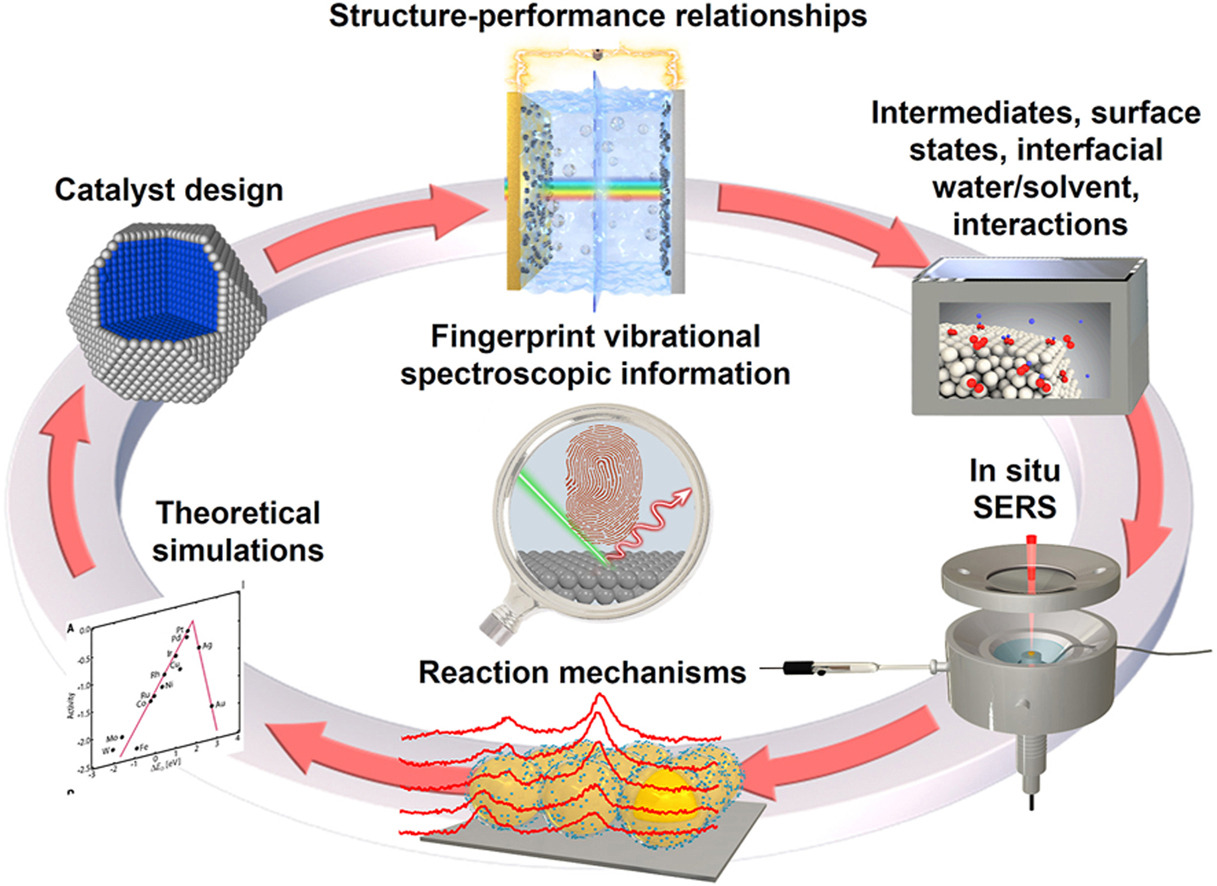
Integrated EC-SERS Framework for Decoding Electrocatalytic Mechanisms
GA, UNITED STATES, December 23, 2025 /EINPresswire.com/ -- Electrocatalysis underlies hydrogen production, fuel cells, and carbon-neutral chemical synthesis, which enables next-generation clean-energy systems rely on fast and selective redox reactions at solid–liquid interfaces, yet their mechanisms have remained difficult to resolve. This is due to the complexity of electrochemical interfaces and trace amounts and transient process of interfacial species, which include intermediates, surface states of electrocatalysts, interfacial water/solvent, and their interactions. Due to these challenges, deeper investigation of interfacial electrocatalytic processes is urgently needed. Traditional electrochemical methods detect only global current–voltage responses at macro scale and cannot resolve molecular bonding, electric-field effects, or interfacial water structure, all of which regulate reaction pathways and mechanisms. Techniques such as XRD, XPS, TEM, IR, and XAS provide valuable information yet lack the surface sensitivity needed to identify individual interfacial species during operation.
In situ electrochemical surface-enhanced Raman spectroscopy (EC-SERS) overcomes these limitations by amplifying Raman signals at plasmonic nanostructures, enabling real-time detection of interfacial species. This review highlights how in situ EC-SERS captures fingerprint vibrational signals of trace and transient interfacial species under operational conditions. By tracking dynamically evolutional Raman peaks of interfacial species, EC-SERS reveals how electrocatalyst properties and interfacial environments govern fuel cell, water electrolysis, and CO2RR related reactions. These insights establish direct correlations between interfacial species, reaction pathways, and reaction mechanisms, offering powerful guidance for designing high-performance electrocatalysts and electric double layer (EDL) for sustainable energy technologies.
This comprehensive review has been summarized by a team of researchers and has published in eScience detailing how in situ EC-SERS enables unprecedented mechanistic understanding of electrocatalytic reactions. Released in 2025, the work outlines the principles, substrate-engineering strategies, and experimental designs that allow Raman enhancement to be coupled with electrochemical control. The review demonstrates how EC-SERS identifies intermediates, surface states of electrocatalysts, interfacial water/solvent, and their interactions in hydrogen, oxygen, and CO₂ conversion systems, providing a molecular-level perspective that strengthens the interpretation of reaction pathways and mechanisms under operating conditions.
The study first describes how localized surface plasmon resonance (LSPR) on Au, Ag, and Cu nanostructures generates intense electromagnetic "hotspots," amplifying Raman signals by several orders of magnitude and enabling detection of monolayer-level species. It summarizes strategies for constructing SERS substrates—including electrochemical roughening, chemical reduction, core–shell nanoparticles, etc.—for electrocatalysts that lack intrinsic Raman activity. Using potential-dependent Raman shifts, vibrational Stark effects, and isotope tracing, EC-SERS distinguishes key intermediates such as H*, OH*, OOH*, COOH*, and surface oxides. Case studies show how EC-SERS differentiates associative versus dissociative oxygen-reduction pathways on Pt single crystals, reveals valence-state-dependent hydrogen-evolution kinetics on Ru surfaces, and identifies bifunctional H/OH interactions governing alkaline hydrogen-oxidation activity in Pt-based alloys. The technique also exposes the structural evolution of interfacial water—its hydrogen-bond network, orientation, and cation-hydration states—offering insights previously inaccessible to other characterization tools. By integrating EC-SERS with DFT and AIMD simulations, the review demonstrates how vibrational frequencies correlate with adsorption energies, reaction barriers, and electric-double-layer structure, thus linking electronic properties directly to electrocatalytic performance across major clean-energy reactions.
According to the authors, EC-SERS provides "molecular-level clarity that was previously unattainable in operando electrocatalysis." They note that subtle shifts in vibrational modes track how electrocatalytic surfaces reorganize, how reaction intermediates appear or disappear, and how interfacial water and cations modulate electron–proton transfer. This ability to visualize species under working conditions, they emphasize, transforms EC-SERS into a mechanistic bridge between spectroscopy and theory. By validating computational predictions and refining reaction models, the technique equips researchers with a robust analytical framework for designing more efficient electrocatalysts and EDL.
The authors highlight that EC-SERS opens powerful avenues for rational electrocatalyst and EDL design in hydrogen production, fuel cells, CO₂ utilization, and other sustainable-energy technologies. By revealing how binding energies, surface electronic structure, and interfacial solvation govern key steps, the method guides precise tuning of electrocatalyst composition, morphology, and active-site configuration, and smart manipulation of ELD ions distribution and gradient, interfacial water/solvent, interfacial electric field, and pH gradient, toward performance improvement. Future developments—including broader potential windows, multimodal spectroscopic integration, improved spatial resolution, and machine-learning-assisted spectral interpretation—could establish EC-SERS as a standard diagnostic tool for operando catalysis. Ultimately, this approach supports the accelerated development of high-efficiency, durable energy-conversion systems essential for a low-carbon future.
References
DOI
10.1016/j.esci.2024.100352
Original Source URL
https://doi.org/10.1016/j.esci.2024.100352
Funding information
This work was supported by the National Natural Science Foundation of China (22574071, 22472074, 22272069, T2293692, 22074058, 22021001, and 21925404), the Natural Science Foundation of Fujian Province, China (2023H01010004 and 2021J01988), and the XMIREM autonomously deployment project, China (2023CX10 and 2023GG01).
Lucy Wang
BioDesign Research
email us here
Legal Disclaimer:
EIN Presswire provides this news content "as is" without warranty of any kind. We do not accept any responsibility or liability for the accuracy, content, images, videos, licenses, completeness, legality, or reliability of the information contained in this article. If you have any complaints or copyright issues related to this article, kindly contact the author above.
