

Global Convenience Food Market Set to Reach USD 1,460.3 Million by 2036 as Urban Consumption Pattern Drive Steady Demand
Convenience Food Market
The global convenience food market is growing steadily, driven by urban lifestyles, changing meal patterns, and expansion of retail and e-commerce channels.
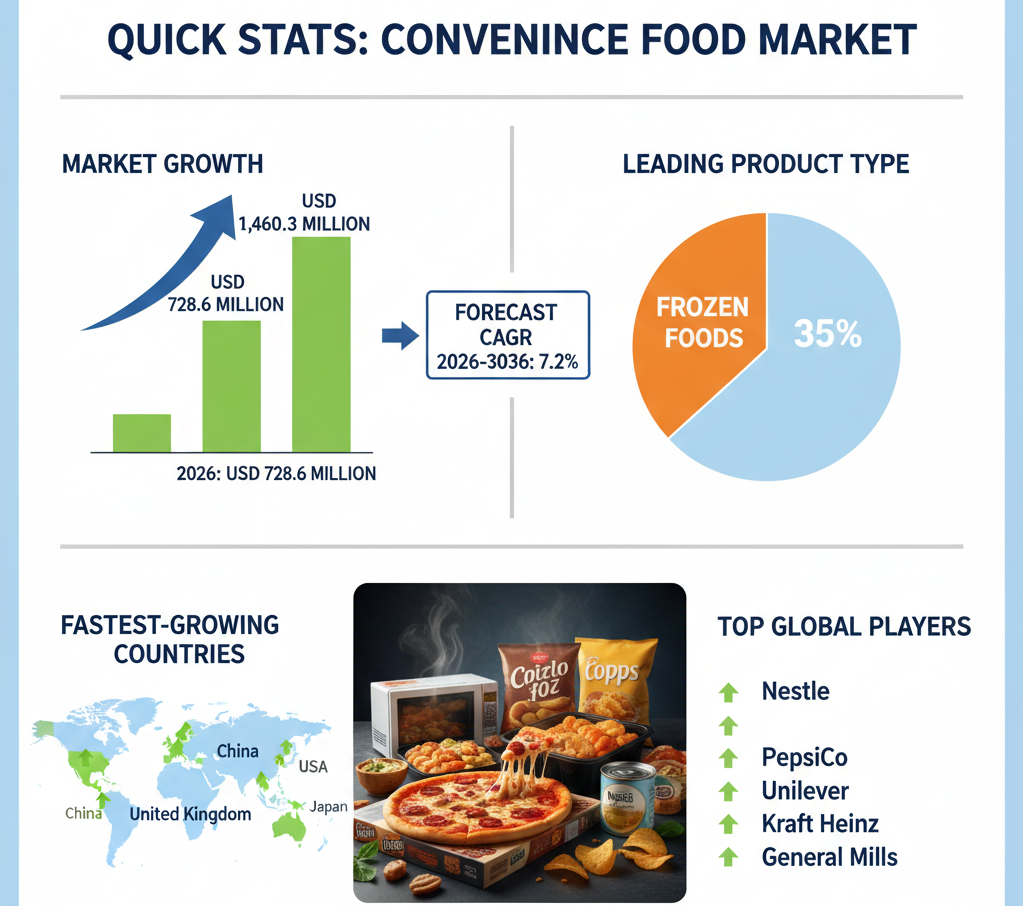
NEWARK, DE, UNITED STATES, January 22, 2026 /EINPresswire.com/ -- The global convenience food market is valued at USD 728.6 million in 2026 and is projected to reach USD 1,460.3 million by 2036, expanding at a compound annual growth rate (CAGR) of 7.2% over the forecast period. Market expansion reflects sustained changes in how food is purchased, prepared, and consumed, particularly in urban and semi-urban regions where time constraints and structured work schedules favor packaged and ready formats.
Growth is concentrated in regions with dense working populations, extended commuting times, and strong retail accessibility. Consumption behavior is largely driven by daily purchasing frequency rather than seasonal stocking, supporting consistent turnover across supermarkets, hypermarkets, and convenience retail formats. Mature markets continue to contribute stable volumes, while emerging urban centers add incremental demand as organized grocery networks expand and household structures shift toward smaller units and single-person households.
Market Context: Urbanization, Mobility, and Distribution Shape Growth
The demand for convenience food is rising as urban lifestyles increasingly prioritize minimal preparation time and predictable meal solutions. Expansion is closely linked to population mobility, workforce participation, and the penetration of organized retail and e-commerce grocery platforms, rather than income growth alone. Regions with advanced cold chain infrastructure and dense retail networks demonstrate stronger value accumulation, while areas with fragmented distribution systems show slower uptake despite rising consumer interest.
Product acceptance varies by geography and depends on local taste adaptation, portion sizing, and compatibility with household storage constraints. Regulatory food standards and labeling requirements influence formulation timelines and market entry strategies across countries. Institutional consumption, including procurement by schools, offices, and healthcare facilities, provides demand stability in regions with structured food programs and recurring purchase cycles.
Key Market Metrics and Performance Indicators
• Market Value (2026): USD 728.6 million
• Forecast Value (2036): USD 1,460.3 million
• Forecast CAGR (2026–2036): 7.2%
• Leading Product Type: Frozen foods
• Leading Distribution Channel: Supermarkets and hypermarkets
Frozen foods account for 35.0% of global demand, representing the largest product category due to extended shelf stability and usage flexibility. Freezing preserves sensory attributes and nutritional integrity while enabling longer storage durations, aligning with household inventory planning and reducing spoilage. Other segments, including canned foods, chilled foods, and ready-to-eat meals, address immediacy-driven consumption needs and shorter usage cycles.
Distribution Channels Reflect Organized Retail Dominance
Supermarkets and hypermarkets represent 40.0% of total market demand, supported by high footfall, broad assortments, and integrated cold storage capabilities. Centralized procurement enables consistent availability across frozen, chilled, and shelf-stable categories. Smaller retail formats, such as convenience stores and neighborhood outlets, contribute accessibility and frequency-based purchases rather than volume scale.
E-commerce platforms further concentrate demand in logistics-ready urban zones, reinforcing habitual purchasing patterns and supporting steady growth without reliance on short-term promotional cycles.
Regional Growth Patterns and Country-Level Outlook
Global demand is expanding across both developed and emerging economies, with growth rates reflecting differences in urbanization, retail infrastructure, and consumption habits.
• China: 7.5% CAGR, driven by rapid urbanization, long working hours, and the expansion of e-commerce grocery and food delivery platforms.
• United States: 6.9% CAGR, supported by strong penetration of frozen meals, ready snacks, and broad retail and online distribution.
• United Kingdom: 5.6% CAGR, reflecting established ready-meal consumption habits and strong supermarket private label presence.
• Germany: 5.5% CAGR, characterized by demand for quality-controlled frozen and refrigerated meals and emphasis on ingredient transparency.
• Japan: 5.0% CAGR, supported by extensive convenience store networks, high urban density, and aging population dynamics.
Market Dynamics: Efficiency, Regulation, and Cost Pressures
Demand for convenience food aligns with standardized preparation, shelf stability requirements, and efficient distribution systems. However, market scalability is influenced by input cost volatility, regulatory scrutiny around additives and labeling, and infrastructure gaps in cold storage and transportation. Pricing sensitivity remains high in inflationary environments, while compliance costs and formulation complexity increase operational requirements for manufacturers.
Explore trends before investing – request a sample report today! https://www.futuremarketinsights.com/reports/sample/rep-gb-96
Competitive Landscape and Industry Participation
The global convenience food market features established multinational suppliers with broad category portfolios and strong distribution capabilities. Key players include Nestlé, PepsiCo, Unilever, Kraft Heinz, and General Mills, each offering diversified convenience food products across frozen, chilled, and shelf-stable segments. Competitive differentiation is driven by portfolio breadth, supply chain reliability, regulatory compliance, and responsiveness to evolving nutritional expectations.
Key Players in the Convenience Food Market
• Nestlé
• PepsiCo
• Unilever
• Kraft Heinz
• General Mills
Browse Related Insights
Ready-to-eat Food Market: https://www.futuremarketinsights.com/reports/ready-to-eat-food-market
Ready-to-eat Cups Market: https://www.futuremarketinsights.com/reports/ready-to-eat-cups-market
Ready-to-eat Canned Tuna Market: https://www.futuremarketinsights.com/reports/ready-to-eat-canned-tuna-market
About Future Market Insights (FMI)
Future Market Insights, Inc. (FMI) is an ESOMAR-certified, ISO 9001:2015 market research and consulting organization, trusted by Fortune 500 clients and global enterprises. With operations in the U.S., UK, India, and Dubai, FMI provides data-backed insights and strategic intelligence across 30+ industries and 1,200 markets worldwide.
Sudip Saha
Future Market Insights Inc.
+18455795705 ext.
email us here
Legal Disclaimer:
EIN Presswire provides this news content "as is" without warranty of any kind. We do not accept any responsibility or liability for the accuracy, content, images, videos, licenses, completeness, legality, or reliability of the information contained in this article. If you have any complaints or copyright issues related to this article, kindly contact the author above.
