

Next-Generation Water Hammer Control System Market Trends 2026-2036: Innovation Catalysts, Regulatory Impact
Water Hammer Control System Market
Global Water Hammer Control System Market Projected to Experience Robust Growth Through 2036 Amid Increasing Infrastructure Modernization
ROCKVILLE, MD, UNITED STATES, January 22, 2026 /EINPresswire.com/ -- A comprehensive market analysis released by Fact.MR, a leading business intelligence firm, reveals that the global Water Hammer Control System Market is poised for significant expansion between 2026 and 2036. Driven by the urgent need to protect aging pipeline infrastructure and the global surge in smart water management, the market is becoming a critical focal point for industrial and municipal stakeholders worldwide.Water hammer, or hydraulic shock, occurs when a fluid in motion is forced to stop or change direction suddenly, creating a pressure surge that can lead to catastrophic pipe bursts, pump failures, and systemic downtime. As municipal water utilities and industrial facilities across North America, Europe, and Asia-Pacific face tightening regulatory standards and the high costs of infrastructure repair, the adoption of advanced control systems has shifted from a secondary safety measure to a primary operational necessity.
Request for Sample Report | Customize Report |purchase Full Report - https://www.factmr.com/connectus/sample?flag=S&rep_id=13785
Core Market Drivers: Safety, Efficiency, and Regulation
The opening of the forecast period in 2026 marks a pivotal transition for the industry. Key factors propelling this decade-long growth include:
Infrastructure Integrity: Urban centers are increasingly prioritizing the mitigation of physical risks to water distribution networks. Systems designed to dampen pressure surges—including bladder tanks, surge vessels, and specialized control valves—are seeing heightened demand.
Industrial Automation: The integration of Industry 4.0 technologies is allowing for real-time monitoring of pressure transients. Smart water hammer control systems now offer predictive maintenance capabilities, reducing long-term operational expenditures.
Environmental and Resource Scarcity: With global water scarcity intensifying, preventing unaccounted-for water (UFW) caused by pipe leaks and bursts is a top priority for utility providers.
Regional Outlook: Asia-Pacific and North America Lead Demand
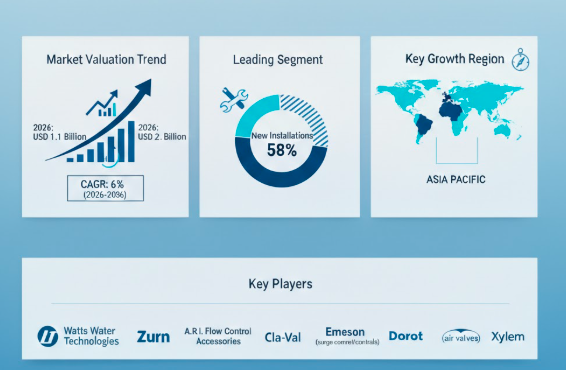
The report identifies Asia-Pacific as a dominant growth engine through 2036. Rapid urbanization in India and China, coupled with massive government investments in mega-irrigation projects and wastewater treatment facilities, has created a fertile environment for market expansion.
Meanwhile, North America remains a steady contributor, characterized by the replacement of antiquated municipal systems and a high concentration of key market players focusing on product innovation. The U.S. market, in particular, is benefiting from federal funding aimed at upgrading national water safety and resilience standards.
Sector Analysis: Municipal vs. Industrial Applications
While the municipal sector remains the largest consumer of water hammer control solutions due to the sheer scale of public water networks, the industrial segment—specifically oil & gas, power generation, and chemical processing—is expected to register a higher compound annual growth rate (CAGR). The high-pressure nature of these operations makes them uniquely vulnerable to hydraulic shock, necessitating specialized, high-performance control systems.
Strategic Competitive Landscape
The market is characterized by a mix of established engineering firms and emerging technology startups. Leading manufacturers are focusing on:
Hybrid Solutions: Combining mechanical arrestors with electronic surge-sensing technology.
Custom Engineering: Developing site-specific surge analysis (transient analysis) to provide tailored control configurations.
Sustainability: Reducing the carbon footprint of system manufacturing and improving the energy efficiency of pump-start control sequences.
Looking Ahead: 2026–2036
As the market moves toward the 2036 horizon, the focus is expected to shift toward autonomous control systems capable of mitigating surges without human intervention. Analysts at Fact.MR suggest that the convergence of digital twins and hydraulic modeling will redefine how engineers approach surge protection, making water hammer control an invisible but essential backbone of modern fluid transport.
For industry leaders and investors, the 2026–2036 outlook represents a decade of smart protection, where the cost of prevention is significantly outweighed by the risk of system failure.
About Fact.MR Fact.MR is a distinguished market research company renowned for its comprehensive market reports and invaluable business insights. As a prominent player in business intelligence, Fact.MR delivers deep analysis, uncovering market trends, growth paths, and competitive landscapes, empowering businesses with crucial data for informed decision-making.
To View related Reports:
Bottled Water Market
https://www.factmr.com/report/198/bottled-water-market
Water Service Module for Steam Boilers Market
https://www.factmr.com/report/593/water-service-module-steam-boilers-market
Feedwater Treatment Chemical Market
https://www.factmr.com/report/637/feedwater-treatment-chemicals-market
Mobile Water Treatment System Market
https://www.factmr.com/report/667/mobile-water-treatment-systems-market
S. N. Jha
Fact.MR
+1 628-251-1583
email us here
Legal Disclaimer:
EIN Presswire provides this news content "as is" without warranty of any kind. We do not accept any responsibility or liability for the accuracy, content, images, videos, licenses, completeness, legality, or reliability of the information contained in this article. If you have any complaints or copyright issues related to this article, kindly contact the author above.
