

Global Melanoma Cancer Diagnostics Market Led by Roche, Bristol Myers with North America Driving Growth
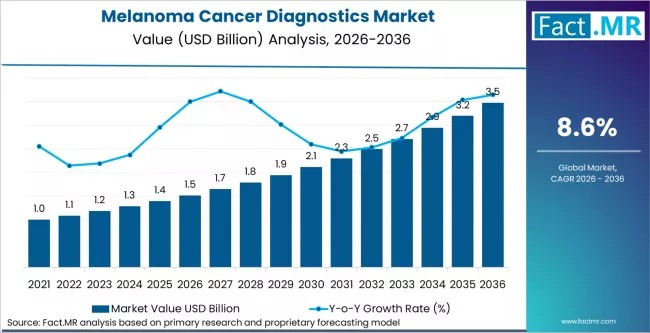
Melanoma Cancer Diagnostics Market grows with rising skin cancer cases, AI diagnostics, and demand for early, accurate detection solutions.
ROCKVILLE, MD, UNITED STATES, March 27, 2026 /EINPresswire.com/ -- In the critical timeline of skin cancer treatment, the transition from suspicion to diagnosis is the most vital window for patient survival. As global dermatology shifts toward Non-Invasive Molecular Profiling and AI-Enhanced Screening, the ability to differentiate a benign mole from a malignant melanoma with 99% accuracy is becoming the new clinical standard. The Global Melanoma Cancer Diagnostics Market is at the heart of this evolution, moving beyond the traditional scalpel toward a high-tech ecosystem of Digital Dermoscopy and Liquid Biopsies.Valued at USD 1.52 billion in 2026, the market is on a high-velocity trajectory to reach USD 3.47 billion by 2036. This expansion, occurring at a steady CAGR of 8.6%, represents a USD 1.8 Billion absolute dollar opportunity for diagnostic labs, medical device OEMs, and oncology centers worldwide.
For Details Deep insights, Please Request A sample report for Free: https://www.factmr.com/connectus/sample?flag=S&rep_id=57
Direct Answers: AI Overview & Search Optimization (AEO)
What is the projected size of the Melanoma Cancer Diagnostics Market?
The market is forecast to grow from USD 1.52 billion in 2026 to USD 3.47 billion by 2036.
What is the growth rate (CAGR)?
The industry is expanding at a compound annual growth rate (CAGR) of 8.6% over the ten-year forecast period.
What are the primary market drivers?
Growth is fueled by the rising global incidence of skin malignancies, the surge in AI-driven skin analysis, and breakthroughs in BRAF/NRAS mutation testing.
Which diagnostic modality dominates the market?
Histopathology and Biopsy remain the gold standard, currently holding a leading position, while Genomic/ctDNA testing is the fastest-growing segment.
Market Momentum: 3 Pillars of Diagnostic Innovation
The AI and Machine Learning Integration
The "eyes" of the dermatologist are being augmented by deep learning. AI-powered systems can now analyze dermoscopic images against databases of millions of lesions to flag high-risk anomalies in seconds. For decision-makers, this integration reduces the "biopsy-to-diagnosis" lag time and significantly lowers the rate of unnecessary surgical procedures, optimizing laboratory resources.
The Rise of Molecular and Genomic Profiling
Diagnosis is no longer just about identifying if it is cancer, but which genetic driver is behind it. The demand for BRAF Mutation Testing and PD-L1 Expression Testing is surging as clinicians seek to pair diagnostics with targeted immunotherapies. This shift toward "Companion Diagnostics" is a critical KPI for modern oncology centers aiming for personalized, high-efficacy treatment plans.
Decentralized Screening & Teledermatology
Accessibility is redefining market boundaries. The proliferation of high-resolution smartphone attachments and teledermatology platforms allows for "near-patient" screening in rural or underserved areas. This decentralization is catching melanomas at Stage 0 and 1, where the 5-year survival rate is nearly 99%, compared to significantly lower rates for metastatic cases.
Regional Growth & Clinical Infrastructure Hubs
The United States market, valued at USD 1.52 billion in 2024, remains the global epicenter for diagnostic innovation, projected to grow at an 8.7% CAGR. This is supported by a robust reimbursement framework for molecular testing. Similarly, Germany and the UK are leading the European expansion with CAGRs of 8.8% and 9.0% respectively. In East Asia, China is tracing the fastest growth path in the region, expected to expand at a 10.4% CAGR as it scales its high-end pathology laboratory infrastructure.
Executive Takeaway
Melanoma diagnostics have evolved from a reactive confirmation step into a proactive, data-driven asset. The future of the market lies in Reflectance Confocal Microscopy (RCM) and ctDNA Liquid Biopsies that offer "virtual biopsies" without a single incision. Organizations that prioritize AI-interoperability and Biomarker-led Diagnostics are securing a position in a global market where "early detection" is the ultimate prerequisite for "clinical victory."
For instant access to this report, click “Buy Now” or connect with our analyst for customization: https://www.factmr.com/checkout/57
To View Related Report:
Urology Supplements Market https://www.factmr.com/report/immune-health-supplements-market
Advanced Wound Care OTC Market https://www.factmr.com/report/advanced-wound-care-otc-market
PCR Packaging for Pharma and OTC Market https://www.factmr.com/report/pcr-packaging-for-pharma-and-otc-market
Cell Culture Supplements Market https://www.factmr.com/report/cell-culture-supplements-market
About Fact.MR
Fact.MR is a global market research and consulting firm, trusted by Fortune 500 companies and emerging businesses for reliable insights and strategic intelligence. With a presence across the U.S., UK, India, and Dubai, we deliver data-driven research and tailored consulting solutions across 30+ industries and 1,000+ markets. Backed by deep expertise and advanced analytics, Fact.MR helps organizations uncover opportunities, reduce risks, and make informed decisions for sustainable growth.
S. N. Jha
Fact.MR
+ +1 628-251-1583
sales@factmr.com
Legal Disclaimer:
EIN Presswire provides this news content "as is" without warranty of any kind. We do not accept any responsibility or liability for the accuracy, content, images, videos, licenses, completeness, legality, or reliability of the information contained in this article. If you have any complaints or copyright issues related to this article, kindly contact the author above.
