

Global Leading Multi-Directional Drive Wheels Manufacturer vs Conventional Drive Systems: Key Differences
1. Kinematic Evolution: Beyond the Limits of Skid-Steering and Differential Drive
Conventional mobile robot platforms typically rely on differential drive systems. These systems achieve turns by varying the speeds of two independent wheels. While this design is mechanically simple, it relies on "skid-steering" principles that introduce several operational inefficiencies. When a robot turns using differential speeds, the wheels experience a "scrubbing" effect against the floor. This friction increases energy consumption and accelerates tire wear, leading to more frequent maintenance intervals. Furthermore, differential systems struggle to maintain precise paths during complex maneuvers, as the reliance on speed variance can lead to unpredictable drift.
In contrast, multi-directional drive wheels utilize active steering mechanisms to control the direction of travel. This kinematic evolution represents a move toward "true" motion control. Instead of forcing a turn through speed differences, the steering drive unit physically rotates to the desired angle. This approach eliminates the scrubbing effect and ensures that the drive energy translates directly into movement rather than heat and friction. Consequently, robots equipped with these advanced units exhibit much smoother motion profiles. They can navigate tight corners with high-frequency industrial cycles without the mechanical stress associated with traditional skid-steering.
The transition to active steering also enhances the predictability of the robot's path. Differential systems often require complex software compensation to correct for uneven floor surfaces or varying payloads. Active steering units, like those provided by specialized manufacturers, offer a more deterministic mechanical response. This reliability simplifies the high-level navigation algorithms and allows the robot to maintain a higher average speed across the facility floor.
2. Precision and Path Optimization: The Superiority of Active Steering Control
High-precision industrial applications require more than just the ability to move; they require the ability to dock with sub-millimeter accuracy. Conventional drive systems often struggle with the final centimeters of a docking maneuver. Because differential drives cannot move laterally, the robot must perform multiple forward and backward adjustments to align correctly with a station. These "hunting" movements waste time and increase the complexity of the control software.
Modern multi-directional drive systems solve this issue through the integration of high-resolution encoders and advanced servo control. For example, a vertical drive wheel with steering allows for precise angular adjustments that are independent of the drive speed. This separation of steering and propulsion enables the robot to perform "zero-radius" turns and fine-tuned lateral corrections. By using integrated drive units, engineers can achieve a level of positioning precision that was previously unattainable with fragmented components.
Plutools addresses these precision requirements by combining high-performance motors with integrated controllers. This mechatronic synergy ensures that the feedback loop between the encoder and the drive system is as tight as possible. When the robot receives a command to adjust its heading by a fraction of a degree, the steering drive responds instantaneously. This capability is vital for automated assembly lines where robots must interact with fixed machinery or pick up payloads with minimal tolerance for error.
3. Spatial Dynamics: Enabling Lateral Mobility in High-Density Environments
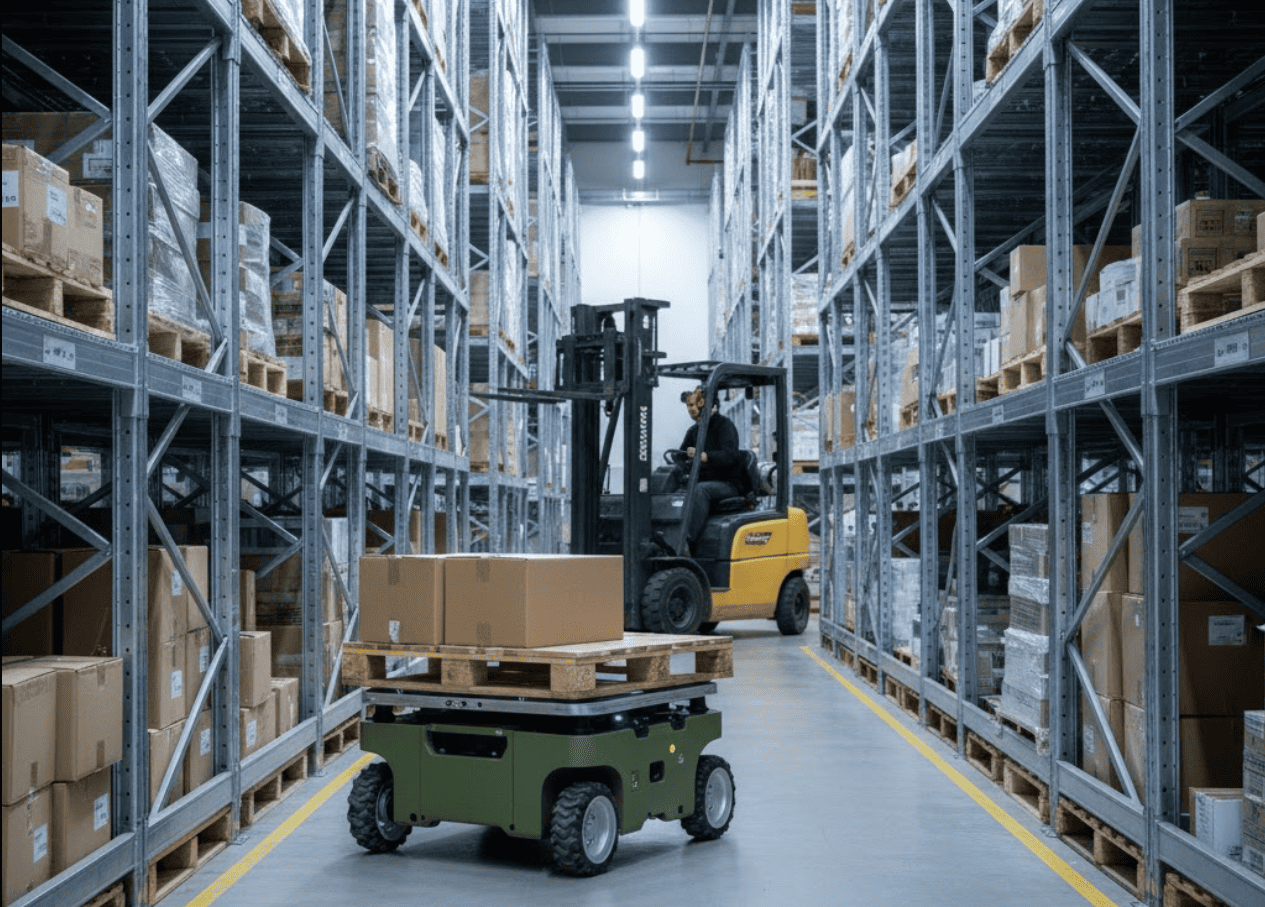
Space is a premium commodity in modern warehouses. Facilities are increasingly adopting high-density storage layouts with narrow aisles to maximize every square meter of floor space. Conventional AGVs often require wide turning radii to navigate these environments, which forces facility managers to design aisles around the limitations of the robots. This traditional approach limits the overall storage capacity of the warehouse.
Multi-directional drive wheels fundamentally change the spatial dynamics of the facility. These units enable "crab-walk" and diagonal movements, allowing robots to enter and exit narrow aisles without needing to turn their entire chassis. A robot equipped with parallel horizontal drive wheels can move sideways directly into a charging station or a storage rack. This lateral mobility reduces the required aisle width and allows for much tighter facility layouts.
Furthermore, the mechanical design of the drive unit influences the robot's physical height. Horizontal drive configurations allow for an extremely low center of gravity and a compact chassis height. This is particularly beneficial for AMRs that must navigate under shelving units or transport heavy racks. By reducing the turning radius to zero and enabling omnidirectional agility, specialized drive systems allow facility managers to reclaim valuable space and improve the overall density of their operations.
4. Mechanical Architecture: Comparing Integration Complexity and Maintenance Cycles
The mechanical architecture of a robot directly impacts its long-term reliability and the total cost of ownership. Conventional systems often consist of fragmented parts—separate motors, gearboxes, encoders, and wheels—sourced from different vendors. This fragmented approach increases the complexity of the bill of materials (BOM) and creates multiple potential points of failure. Integration becomes a significant engineering hurdle, as designers must ensure that components from various sources work in harmony.
Leading manufacturers now offer integrated drive modules that combine all essential motion components into a single housing. An integrated drive unit significantly reduces the BOM and simplifies the assembly process for OEMs. Because the motor, gearbox, and steering mechanism are designed together, they offer better thermal management and higher torque density. This integration also leads to longer maintenance cycles. When components are perfectly matched, they experience less vibration and mechanical stress, which extends the life of the bearings and gears.
The history of the supplier also plays a critical role in mechanical reliability. Shanghai Plutools Automation Co., Ltd. brings over 22 years of experience in R&D and manufacturing to the industry. As a National "Little Giant" enterprise, the company has a long track record of developing breakthroughs in motion control technologies. With a 10,000-square-meter production facility and over 200 patents, the focus remains on industrial applications that require high-strength, reliable hardware. This depth of experience ensures that the mechanical architecture of the drive system can withstand the rigors of continuous industrial use.
5. From Standardization to Future-Proofing: Customization as a Strategic Advantage
Standardization has its place, but the diverse world of industrial robotics often requires tailored solutions. Conventional drive systems usually offer limited options for customization. Manufacturers are often forced to adapt their robot designs to the constraints of the available drive hardware. This can lead to compromises in performance or the need for expensive workarounds.
Conversely, a strategic partnership with a specialized manufacturer provides access to a "Specialized and Innovative" engineering team. Future-proofing a robot fleet requires the ability to customize torque curves, mounting interfaces, and environmental protection ratings. Plutools offers comprehensive customization services that allow OEMs to tailor drive units to specific torque and space requirements. Whether the application involves a specialized agricultural robot or a heavy-duty industrial forklift, the drive system can be optimized for the unique load and terrain conditions of that sector.
Establishing a long-term partnership with a proven leader ensures that the technology remains relevant as the industry evolves. A supplier with 22 years of R&D history (since 2005) provides the commercial trust and technical backup necessary for global scaling. By choosing a partner that emphasizes technical accuracy and objective engineering standards, companies can build robotic platforms that are not only efficient today but also adaptable to the logistics challenges of tomorrow. This strategic approach transforms a simple hardware purchase into a foundation for long-term industrial growth.
In conclusion, the differences between multi-directional drive wheels and conventional systems extend far beyond simple movement. The move toward integrated, actively steered, and customizable motion modules represents the future of mobile robotics. Manufacturers who embrace these advanced technologies gain a significant advantage in precision, spatial efficiency, and mechanical reliability.
For more information on high-performance multi-directional drive solutions, visit https://www.plutools.com/.
Shanghai Plutools Automation Corporation Limited
Shanghai Plutools Automation Corporation Limited
+ +86 15989586580
Eric.Tang@plutools.com
Visit us on social media:
LinkedIn
YouTube
X
Legal Disclaimer:
EIN Presswire provides this news content "as is" without warranty of any kind. We do not accept any responsibility or liability for the accuracy, content, images, videos, licenses, completeness, legality, or reliability of the information contained in this article. If you have any complaints or copyright issues related to this article, kindly contact the author above.
