

The euro area bank lending survey - First quarter of 2026
In the bank lending survey (BLS) on the first quarter of 2026, euro area banks reported a further net tightening of credit standards for loans or credit lines to firms (net percentage of banks of 10%; see Overview table). The tightening was larger than expected, standing above the historical average, and the most pronounced since the third quarter of 2023, extending a cumulative tightening trend that began in mid-2025. Perceived risks to the economic outlook and a lower risk tolerance of banks were the main contributing factors, with banks indicating in a dedicated open-ended question that geopolitical and energy developments exerted tightening pressure. Some banks reported additional tightening related to exposures to energy-intensive firms and to the Middle East. Across the euro area countries with the largest economies, banks in Spain, France and Germany reported tighter credit standards for firms, whereas banks in Italy indicated no change in credit standards. For the second quarter of 2026, banks expect a widespread and more marked net tightening of credit standards for loans to firms (19%).
Banks reported a small net tightening of credit standards for housing loans, while credit standards for consumer credit tightened further (net percentages of 2% and 15% respectively). For housing loans, risk perceptions had a tightening impact on credit standards, while competition had a small easing effect. The lower risk tolerance and higher risk perceptions of banks were the main drivers of the tightening for consumer credit. Across the largest euro area countries, credit standards for housing loans tightened in Germany and Spain and remained unchanged in Italy and France. The tightening of credit standards for housing loans was broadly in line with banks’ expectations, whereas the tightening for consumer credit was stronger than anticipated. For the second quarter of 2026, banks expect credit standards to tighten further for both housing loans (8%) and consumer credit (13%).
Banks reported a slight net decrease in loan demand for firms in the first quarter of 2026 (net percentage of -2%; see Overview table), in contrast to the expectations of increased demand outlined in the previous survey. The actual developments contrast with banks’ expectations for the same quarter, as they had anticipated a moderate increase of 6% following three consecutive quarters of modest but positive growth in demand. The net decrease was mainly driven by a decrease in demand for fixed investment (-7%), partially offset by increased demand for inventories and working capital (2%), primarily among SMEs. In a specific open-ended question, some banks highlighted that ongoing developments in energy prices were driving increased liquidity demand from firms, while others pointed to higher uncertainty and the postponement of investments as dampening factors for demand. Across the largest euro area countries, demand for loans to firms increased in Germany, while remaining unchanged in France and decreasing in Italy and Spain. For the second quarter of 2026, banks expect a more pronounced net decrease in demand for loans (-10%).
Banks reported unchanged demand for housing loans, whereas demand for consumer credit decreased strongly (net percentages of 0% and -11% respectively). Deteriorating consumer confidence and developments in interest rates contributed negatively to demand for housing loans. Changes in housing loan demand were weaker than banks’ expectations (3%). Consumer credit demand declined further, reflecting weaker spending on durable goods and lower consumer confidence, as well as a negative contribution from the general level of interest rates. The decrease in demand for consumer credit contrasts with banks’ previous expectations of a minor increase (2%). For the second quarter of 2026, banks expect further declines in demand for housing loans (-20%) and consumer credit (-9%).
Euro area banks’ overall credit terms and conditions tightened for loans to firms and consumer credit, while they remained unchanged for housing loans. For firms, this was the second consecutive quarter of tightening and it was driven mainly by lending rates, while collateral requirements also contributed. For housing loans, narrower margins on average loans and developments in lending rates had an easing effect. For consumer credit, the tightening of overall terms and conditions took place despite narrower margins on average loans and lower lending rates.
Banks reported a net increase in the share of rejected loan applications for all borrower groups. The net increase in the share was higher for consumer credit (14%) than for firms and housing loans (3%).
The April 2026 BLS round contained the following ad hoc questions:
- Euro area banks’ access to debt securities, money markets and securitisations deteriorated in the first quarter of 2026, while it remained broadly unchanged for retail funding. The deterioration in access to debt securities, the most significant since the first quarter of 2023, was driven by both short-term and medium to long-term securities. While access to short-term retail funding remained unchanged, access to long-term retail funding deteriorated. Over the next three months, banks expect access to debt securities, retail and money market funding, and to securitisation markets, to deteriorate.
- Euro area banks reported a net tightening impact of non-performing loan (NPL) ratios and other credit quality indicators on their credit standards for loans to firms and consumer credit in the first quarter of 2026, while credit standards for housing loans were broadly unaffected. Banks indicated that higher risk perceptions, lower risk tolerance, pressure stemming from supervisory or regulatory requirements and costs related to balance sheet clean-up operations contributed to the net tightening. For the second quarter of 2026, euro area banks expect credit quality to have a further tightening impact on their credit standards for loans to firms and, more markedly, for consumer credit.
- Banks reported a neutral impact of the ECB key interest rate decisions on their net interest income over the past six months, with a small negative impact on margins offsetting a small positive impact through volumes. Euro area banks expect a higher margin effect and a lower volume effect from ECB key interest rate decisions in the next two quarters, with a positive overall effect on profitability.
- In response to a new question on banks’ securitisation activities and their impact on lending, nearly half of euro area banks reported using either traditional or synthetic securitisation. Synthetic significant risk transfer (SRT) is the most commonly cited form of securitisation deemed important by euro area banks, followed by non-SRT traditional securitisation and SRT traditional securitisation. Euro area banks identified freeing up capital to issue new loans as the primary motivation for securitising loans, followed by improving their liquidity position, managing credit risks, improving access to funding, meeting regulatory or supervisory requirements, following market trends and distributing capital. Private investment funds and insurance corporations and pension funds were highlighted as the most significant investors purchasing securitised loans, followed by supranational institutions, other banks and other non-bank financial institutions. Banks reported that securitisation contributed to supporting loan volumes across all market segments over the past year, especially for loans to firms, while its contribution to easing credit standards during the same period was minimal. Looking ahead, banks anticipate an increasingly positive impact of securitisation on lending volumes across all segments over the next 12 months, especially for loans to firms.
Overview table
Latest BLS results for the largest euro area countries
(net percentages of banks reporting a tightening of credit standards or an increase in loan demand)
Country |
Enterprises |
House purchase |
Consumer credit |
|||||||||||||||
|---|---|---|---|---|---|---|---|---|---|---|---|---|---|---|---|---|---|---|
Credit standards |
Demand |
Credit standards |
Demand |
Credit standards |
Demand |
|||||||||||||
Q4 25 |
Q1 26 |
Avg |
Q4 25 |
Q1 26 |
Avg |
Q4 25 |
Q1 26 |
Avg |
Q4 25 |
Q1 26 |
Avg |
Q4 25 |
Q1 26 |
Avg |
Q4 25 |
Q1 26 |
Avg |
|
Euro area |
7 |
10 |
8 |
3 |
-2 |
-1 |
-2 |
2 |
6 |
9 |
0 |
2 |
6 |
15 |
5 |
-2 |
-11 |
0 |
Germany |
16 |
16 |
4 |
6 |
3 |
5 |
11 |
4 |
4 |
4 |
-4 |
8 |
11 |
11 |
2 |
0 |
-18 |
7 |
Spain |
0 |
25 |
8 |
-17 |
-8 |
-6 |
0 |
10 |
13 |
20 |
-10 |
-7 |
8 |
17 |
10 |
0 |
-8 |
-6 |
France |
10 |
9 |
6 |
-10 |
0 |
-5 |
-14 |
0 |
2 |
14 |
0 |
3 |
9 |
31 |
0 |
-18 |
-38 |
-3 |
Italy |
0 |
0 |
10 |
9 |
-27 |
3 |
0 |
0 |
1 |
36 |
0 |
10 |
8 |
8 |
5 |
15 |
15 |
9 |
Notes: “Avg” refers to historical averages, which are calculated over the period since the beginning of the survey, excluding the most recent round. Owing to the different sample sizes across countries, which broadly reflect the differences in the national shares in lending to the euro area non-financial private sector, the size and volatility of the net percentages cannot be directly compared across countries.
Box 1
General notes
The BLS is addressed to senior loan officers at a representative sample of euro area banks, representing all euro area countries and reflecting the characteristics of their respective national banking structures. The main purpose of the BLS is to enhance the Eurosystem’s knowledge of bank lending conditions in the euro area.[1]
Detailed tables and charts based on the responses provided can be found in Annex 1 for the standard questions and Annex 2 for the ad hoc questions. In addition, BLS time series data are available on the ECB’s website through the ECB Data Portal – see also the notes to charts throughout this report.
Detailed explanations on the BLS questionnaire, the aggregation of banks’ replies to national and euro area BLS results, the BLS indicators and information on the BLS series keys are available on the ECB’s website in the BLS user guide. A copy of the BLS questionnaire with the standard questions and a glossary of BLS terms can also be found on the ECB BLS webpage.
2.1 Further net tightening of credit standards
Euro area banks reported a further tightening of credit standards for loans or credit lines to firms in the first quarter of 2026 (net percentage of banks of 10%; see Chart 1 and Overview table).[2] The tightening was larger than expected (6%) and the most pronounced since the third quarter of 2023, extending a cumulative tightening trend that began in mid-2025. The cumulated net tightening was 30% since the third quarter of 2024 (i.e. after the start of the latest monetary policy easing cycle), with 9% of euro area banks tightening their credit standards once, 5% twice and 5% three times or more during this period.[3] Across the largest euro area countries, banks in Spain, France and Germany reported tighter credit standards for firms, while those in Italy indicated no change. The net tightening for euro area firms was above both the historical average since 2003 (8%) and the more recent average since 2014 (3%).[4] It was higher for loans to small and medium-sized enterprises (SMEs) than for loans to large firms (net percentages of 10% and 6% respectively; see Chart 2). Across maturities, banks reported a stronger net tightening of credit standards for long-term loans than for short-term loans (net percentage of 10% and 5% respectively).
Perceived risks to the economic outlook and a lower risk tolerance of banks were the main factors contributing to tighter credit standards (see Chart 1 and Table 1). The net tightening was consistent with a persistently high level of risk aversion and an increasingly prudent approach to lending by banks. Among the perceived risks, banks referred both the general economic outlook (12%) and the industry or firm-specific situation (9%) as having a tightening effect. Banks’ cost of funds and balance sheet constraints as well as competition had a broadly neutral impact on credit standards in the first quarter of 2026. In a dedicated open-ended question, a substantial share of banks reported that geopolitical and energy developments had a tightening impact on their credit standards. Across the largest euro area countries, banks in Germany, France and Spain reported higher perceived risks as one of the main factors leading to tightening, with risks to their industry or firm-specific situation being more prominent in Germany while risks to the general economic outlook were reported as more prominent by French and Spanish banks. Banks in Germany and Spain also reported lower risk tolerance as an important factor driving the net tightening. This is consistent with the net tightening impact of banks’ NPL ratios and other indicators of asset quality on credit standards through perceived risks for banks in these countries (see Section 5.2). Banks in Italy mentioned no notable impact from any particular factor.
Chart 1
Changes in credit standards applied to the approval of loans or credit lines to enterprises, and contributing factors
(net percentages of banks reporting a tightening of credit standards and contributing factors)
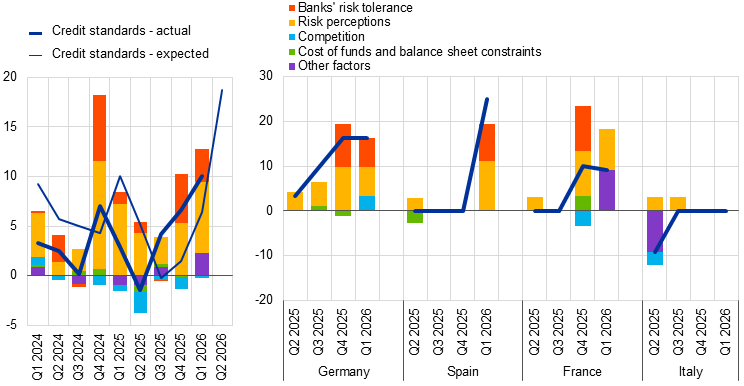
Notes: “Credit standards - actual” are changes that have occurred, while “Credit standards - expected” are changes anticipated by banks. Net percentages are defined as the difference between the sum of the percentages of banks responding “tightened considerably” and “tightened somewhat” and the sum of the percentages of banks responding “eased somewhat” and “eased considerably”. “Cost of funds and balance sheet constraints” is the simple average of “banks’ capital and the costs related to banks’ capital position”, “access to market financing” and “liquidity position”; “Risk perceptions” is the simple average of “general economic situation and outlook”, “industry or firm-specific situation and outlook/borrower’s creditworthiness” and “risk related to the collateral demanded”. “Competition” is the simple average of “competition from other banks”, “competition from non-banks” and “competition from market financing”. The net percentages for “Other factors” refer to an average of the further factors which were mentioned by banks as having contributed to changes in credit standards. The full set of data underlying this chart can be downloaded via the following ECB Data Portal links: euro area and four largest euro area countries.
Chart 2
Changes in credit standards applied to the approval of loans or credit lines to SMEs and large enterprises, and contributing factors
(net percentages of banks reporting a tightening of credit standards and contributing factors)
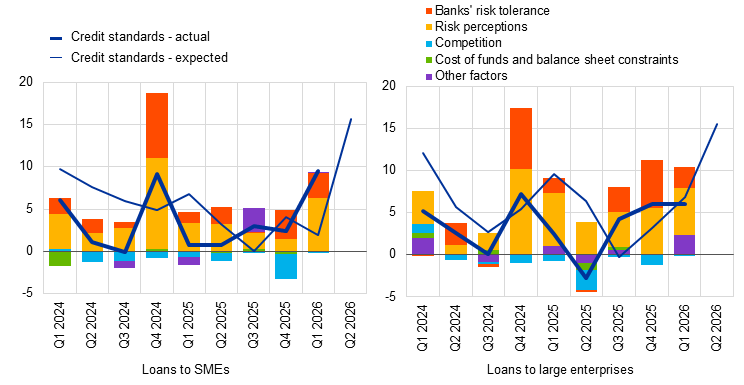
Notes: See the notes to Chart 1. The full set of data underlying this chart can be downloaded via the following ECB Data Portal links: loans to SMEs and loans to large enterprises.
For the second quarter of 2026, banks expect a more marked net tightening of credit standards for loans to firms (net percentage of 19%), broad-based across firm size, loan duration and euro area countries. Banks expect the net tightening of credit standards to be of similar magnitude for loans to large firms and loans to SMEs (15% and 16% respectively). Similarly, they expect credit standards to tighten to the same extent for long-term loans (16%) and short-term loans (15%). Banks in all four major euro area countries expect a net tightening of credit standards for firms for the second quarter of 2026.
Table 1
Factors contributing to changes in credit standards for loans or credit lines to enterprises
(net percentages of banks)
Country |
Cost of funds and |
Pressure from |
Perception of risk |
Banks’ risk tolerance |
||||
|---|---|---|---|---|---|---|---|---|
Q4 2025 |
Q1 2026 |
Q4 2025 |
Q1 2026 |
Q4 2025 |
Q1 2026 |
Q4 2025 |
Q1 2026 |
|
Euro area |
0 |
0 |
-1 |
0 |
5 |
7 |
5 |
3 |
Germany |
-1 |
0 |
0 |
3 |
10 |
6 |
10 |
6 |
Spain |
0 |
0 |
0 |
0 |
0 |
11 |
0 |
8 |
France |
3 |
0 |
-3 |
0 |
10 |
9 |
10 |
0 |
Italy |
0 |
0 |
0 |
0 |
0 |
0 |
0 |
0 |
Note: See the notes to Chart 1.
2.2 Terms and conditions continue to tighten
Euro area banks’ overall credit terms and conditions tightened further for new loans to enterprises (net percentage of 5%; see Chart 3 and Table 2).[5] Banks referred to a net tightening impact of lending rates, consistent with the repricing of euro area risk-free rates since the end of 2025, as well as stricter collateral requirements and margins on riskier loans in the first quarter of 2026. Across the four largest euro area countries, only banks in Germany reported a net tightening of overall terms and conditions – this was larger than in the previous quarter, driven mainly by lending rates, and to a lesser extent by collateral requirements and margins on riskier loans. Overall terms and conditions remained stable in Spain, France and Italy. Across firm size, euro area banks reported a net tightening of overall terms and conditions of broadly similar magnitude for both loans to SMEs and large firms (4% and 5% respectively; see Chart 4).
Chart 3
Changes in terms and conditions on loans or credit lines to enterprises
(net percentages of banks reporting a tightening of terms and conditions)
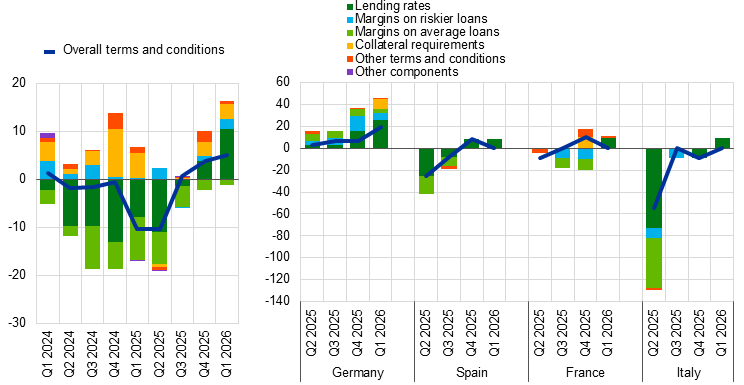
Notes: “Overall terms and conditions” are the actual terms and conditions agreed in the loan contract. “Lending rates” was introduced in April 2024. “Margins” are defined as the spread over relevant market reference rates. “Other terms and conditions” is the simple average of “non-interest rate charges”, “size of the loan or credit line”, “loan covenants” and “maturity”. The net percentages for “Other components” refer to an average of the further terms and conditions components which were mentioned by banks as having contributed to changes in overall terms and conditions. The full set of data underlying this chart can be downloaded via the following ECB Data Portal links: euro area and four largest euro area countries.
Table 2
Changes in terms and conditions on loans or credit lines to enterprises
(net percentages of banks)
Country |
Overall terms and conditions |
Banks’ lending rates |
Banks’ margins on average loans |
Banks’ margins on riskier loans |
||||
|---|---|---|---|---|---|---|---|---|
Q4 2025 |
Q1 2026 |
Q4 2025 |
Q1 2026 |
Q4 2025 |
Q1 2026 |
Q4 2025 |
Q1 2026 |
|
Euro area |
4 |
5 |
4 |
11 |
-2 |
-1 |
1 |
2 |
Germany |
6 |
19 |
16 |
26 |
6 |
3 |
13 |
6 |
Spain |
8 |
0 |
8 |
8 |
0 |
0 |
0 |
0 |
France |
10 |
0 |
0 |
9 |
-10 |
0 |
-10 |
0 |
Italy |
-9 |
0 |
-9 |
9 |
0 |
0 |
0 |
0 |
Note: See the notes to Chart 3.
Higher risk perceptions and lower risk tolerance were the primary drivers of the overall tightening of terms and conditions for euro area firms, while competition had an easing effect (see Table 3). Banks in Germany also reported a tightening impact from increased cost of funds and balance sheet constraints, mainly connected to market financing pressure. Competition had a small easing effect in the past quarter among banks in France, deriving mainly from other banks and alternative market financing, and in Italy, mainly from other banks.
Chart 4
Changes in terms and conditions on loans or credit lines to SMEs and large enterprises
(net percentages of banks reporting a tightening of terms and conditions)
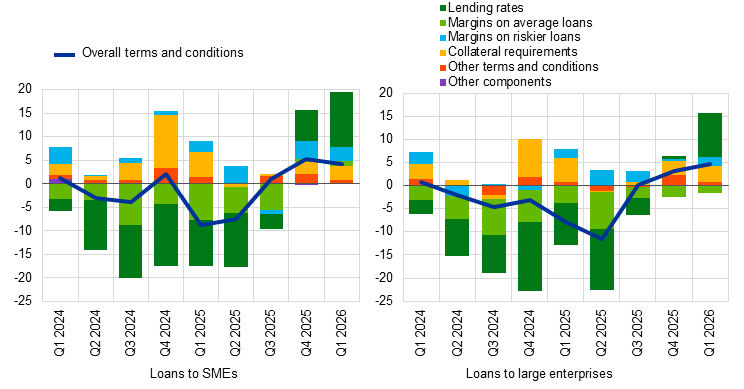
Notes: See the notes to Chart 3. The full set of data underlying this chart can be downloaded via the following ECB Data Portal links: loans to SMEs and loans to large enterprises.
Table 3
Factors contributing to changes in overall terms and conditions for loans or credit lines to enterprises
(net percentages of banks)
Country |
Cost of funds and balance sheet constraints |
Pressure from competition |
Perception of risk |
Banks’ risk tolerance |
||||
|---|---|---|---|---|---|---|---|---|
Q4 2025 |
Q1 2026 |
Q4 2025 |
Q1 2026 |
Q4 2025 |
Q1 2026 |
Q4 2025 |
Q1 2026 |
|
Euro area |
-1 |
1 |
-2 |
-4 |
6 |
10 |
3 |
6 |
Germany |
2 |
4 |
1 |
0 |
5 |
13 |
3 |
6 |
Spain |
0 |
0 |
0 |
0 |
3 |
0 |
0 |
0 |
France |
-3 |
0 |
-7 |
-9 |
17 |
12 |
10 |
9 |
Italy |
-3 |
0 |
0 |
-3 |
0 |
6 |
0 |
9 |
Notes: The net percentages for these questions relating to contributing factors are defined as the difference between the percentage of banks reporting that the given factor contributed to a tightening and the percentage of banks reporting that it contributed to an easing. “Cost of funds and balance sheet constraints” is the simple average of “banks’ capital and the costs related to banks’ capital positions”, “access to market financing” and “liquidity position”. “Perception of risk” is the simple average of “general economic situation and outlook”, “industry or firm-specific situation and outlook/borrower’s creditworthiness” and “risk related to the collateral demanded”. “Pressure from competition” is the simple average of “competition from other banks”, “competition from non-banks” and “competition from market financing”. Aggregate series for “cost of funds and balance sheet constraints”, “perception of risk” and “pressure from competition” were discontinued from the first quarter of 2022, when detailed sub-factors were introduced. The full set of data underlying this chart can be downloaded via the following ECB Data Portal links: euro area and four largest euro area countries.
2.3 Rejection rates increased further
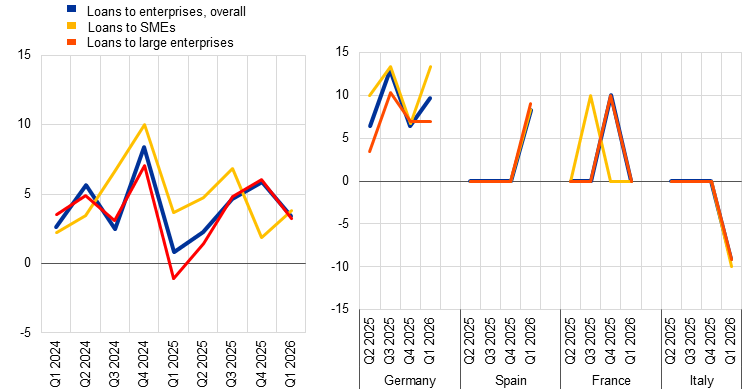
Banks reported a further net increase in the share of rejected loan applications for firms (net percentage of 3%, see Chart 5). The net increase was slightly below that of the previous quarter (6%), and similar for SMEs and large firms (4% and 3% respectively). Banks in Germany and Spain reported a net increase in the share of rejected corporate loan applications in the first quarter of 2026. For Germany, the net increase was larger for loans to SMEs than for loans to large firms, whereas in Spain banks reported a similar net increase in the share of rejected loan applications across firm size. Banks in France indicated unchanged rejection rates for loans to firms, while banks in Italy reported a decrease in the share of rejected loan applications of similar magnitude for SMEs and large firms.
Chart 5
Changes in the share of rejected loan applications for enterprises
(net percentages of banks reporting an increase)
Notes: Share of rejected loan applications relative to the volume of all loan applications in that loan category. The breakdown by firm size was introduced in the first quarter of 2022. The full set of data underlying this chart can be downloaded via the following ECB Data Portal links: euro area and four largest euro area countries.
2.4 Demand for loans decreased slightly, contrary to earlier expectations of an expansion
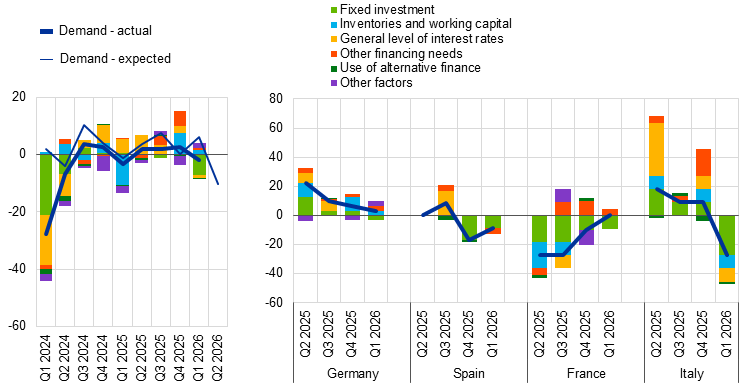
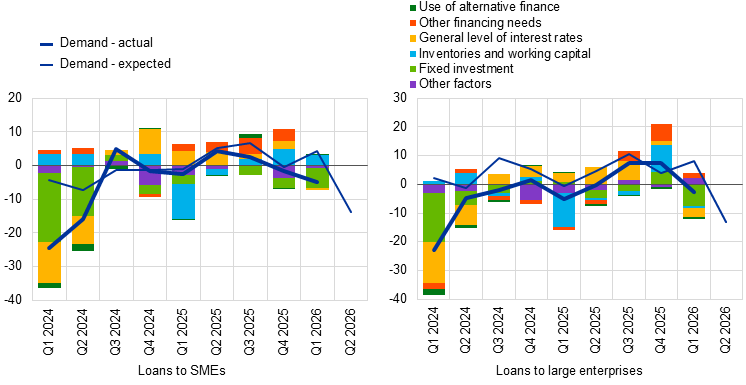
Banks reported a slight net decrease in demand for loans to firms in the first quarter of 2026 (net percentage of -2%; see Chart 6), contrary to earlier expectations of an expansion.[6] The actual developments contrast with banks’ expectations for the same quarter, as they had anticipated a moderate increase (6%) following three consecutive quarters of modest but positive growth in demand. Across the largest euro area countries, demand for loans to firms increased in Germany and was unchanged in France, while it decreased in Italy and Spain. Additionally, responses from banks in Germany and France showed some variation within these countries, with some banks noting an increase in loan demand while others observed a decrease. Symmetrically, in a specific open-ended question some banks mentioned the current energy price developments as possibly driving an increase in loan demand for liquidity needs, while others mentioned a dampening effect on demand from higher uncertainty and the postponement of investments. Across firm sizes, demand for loans decreased slightly for large firms while it decreased more markedly for SMEs (-2% and -5% respectively; see Chart 7). Loan demand decreased for long-term loans while it remained unchanged for short-term loans (-3% and 0% respectively).
Chart 6
Changes in demand for loans or credit lines to enterprises, and contributing factors
(net percentages of banks reporting an increase in demand, and contributing factors)
Notes: “Demand - actual” represents changes that have occurred, while “Demand - expected” represents changes anticipated by banks. Net percentages for the questions on demand for loans are defined as the difference between the sum of the percentages of banks responding “increased considerably” and “increased somewhat” and the sum of the percentages of banks responding “decreased somewhat” and “decreased considerably”. “Other financing needs” is the simple average of “mergers/acquisitions and corporate restructuring” and “debt refinancing/restructuring and renegotiation”. “Use of alternative finance” is the simple average of “internal financing”, “loans from other banks”, “loans from non-banks”, “issuance/redemption of debt securities” and “issuance/redemption of equity”. The net percentages for “Other factors” refer to an average of the further factors which were mentioned by banks as having contributed to changes in loan demand. The full set of data underlying this chart can be downloaded via the following ECB Data Portal links: euro area and four largest euro area countries.
Chart 7
Changes in demand for loans or credit lines to SMEs and large enterprises, and contributing factors
(net percentages of banks reporting an increase in demand, and contributing factors)
Notes: See the notes to Chart 6. The full set of data underlying this chart can be downloaded via the following ECB Data Portal links: loans to SMEs and loans to large enterprises.
The net decrease was mainly driven by a decrease in demand for fixed investment, which was partially offset by increased demand for inventories and working capital, primarily among SMEs (see Chart 6, Chart 7 and Table 4). The reported decrease in demand for fixed investment was the highest since the first quarter of 2024 and was broad-based across all major euro area countries. Inventories and working capital supported demand for loans to SMEs in Germany, where demand for short-term loans was positive, and made a negative contribution to loan demand in Italy, in connection with negative demand for short-term loans. The general level of interest rates had a neutral effect for the first time, after making small positive contributions since the second quarter of 2024, except for Italy where it had a dampening effect on loan demand. By firm size, large firms reported a slightly larger net decrease in financing needs for fixed investment, whereas only SMEs reported a small positive contribution from inventories and working capital (see Chart 7).
Table 4
Factors contributing to changes in demand for loans or credit lines to enterprises
(net percentages of banks)
Country |
Fixed investment |
Inventories and working capital |
Other financing needs |
General level of interest rates |
Use of alternative finance |
|||||
|---|---|---|---|---|---|---|---|---|---|---|
Q4 2025 |
Q1 2026 |
Q4 2025 |
Q1 2026 |
Q4 2025 |
Q1 2026 |
Q4 2025 |
Q1 2026 |
Q4 2025 |
Q1 2026 |
|
Euro area |
0 |
-7 |
8 |
2 |
5 |
1 |
2 |
-1 |
0 |
0 |
Germany |
3 |
-3 |
10 |
3 |
2 |
3 |
0 |
0 |
0 |
0 |
Spain |
-17 |
-8 |
0 |
0 |
0 |
-4 |
0 |
0 |
-2 |
0 |
France |
-10 |
-9 |
0 |
0 |
10 |
5 |
0 |
0 |
2 |
0 |
Italy |
9 |
-27 |
9 |
-9 |
18 |
0 |
9 |
-9 |
-4 |
-2 |
Note: See the notes to Chart 6.
For the second quarter of 2026, banks expect a more pronounced net decrease in loan demand (net percentage of -10%), especially for long-term loans. Banks expect the decline to be robust and concentrated in longer-term loans, while they expect a moderate net increase in demand for short-term loans (-17% and 5% respectively), in line with a demand for credit that is concentrated in liquidity needs rather than long-term investments. Across the four largest euro area countries, banks in France, Italy and Spain expect a further and more marked decrease in loan demand, while banks in Germany expect unchanged demand.
3.1 Small tightening of credit standards
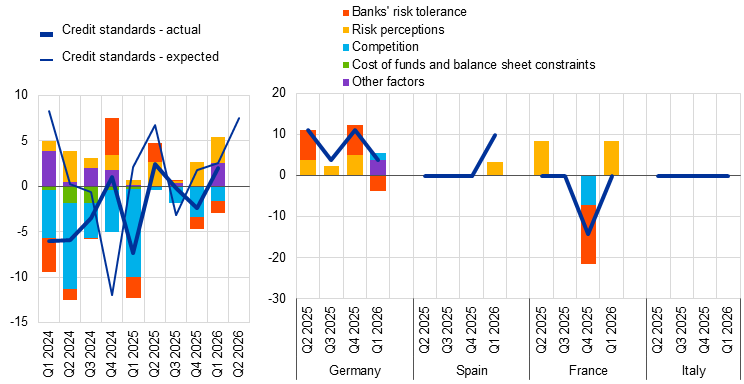
Banks reported a small net tightening of credit standards for housing loans in the first quarter of 2026 (net percentage of 2%, see Chart 8 and Overview table).[7] The small tightening of credit standards for housing loans was broadly in line with banks’ expectations (3%). Among the four largest euro area countries, credit standards tightened in Spain and Germany and remained unchanged in Italy and France.
Chart 8
Changes in credit standards applied to the approval of loans to households for house purchase, and contributing factors
(net percentages of banks reporting a tightening of credit standards, and contributing factors)
Notes: “Credit standards - actual” are changes that have occurred, while “Credit standards - expected” are changes anticipated by banks. Net percentages are defined as the difference between the sum of the percentages of banks responding “tightened considerably” and “tightened somewhat” and the sum of the percentages of banks responding “eased somewhat” and “eased considerably”. “Cost of funds and balance sheet constraints” is the simple average of “banks’ capital and the costs related to banks’ capital positions”, “access to market financing” and “liquidity position” (the aggregate series was discontinued from the first quarter of 2022, when detailed sub-factors were introduced). “Risk perceptions” is the simple average of “general economic situation and outlook”, “housing market prospects, including expected house price developments” and “borrower’s creditworthiness”. “Competition” is the simple average of “competition from other banks” and “competition from non-banks”. The net percentages for “Other factors” refer to an average of the further factors which were mentioned by banks as having contributed to changes in credit standards. The full set of data underlying this chart can be downloaded via the following ECB Data Portal links: euro area and four largest euro area countries.
Risk perceptions had a tightening impact on credit standards, while competition had an easing impact (see Chart 8 and Table 5). Risk perceptions were one of the main factors behind the tightening of credit standards in Spain, reflecting banks’ views on the general economic situation. Banks in Germany reported tightening credit standards owing to competition effects, while risk tolerance was cited as having a small easing impact. Although banks in France reported unchanged credit standards, deteriorating risk perceptions, linked to housing market prospects and the general economic situation, were mentioned as having a tightening effect. Banks in Italy mentioned no notable impact from any particular factor.
For the second quarter of 2026, euro area banks expect to further tighten credit standards on housing loans (net percentage of 8%). Across the four largest euro area economies, the expected tightening is driven by banks in Germany and Spain, while banks in France and Italy anticipate unchanged credit standards.
Table 5
Factors contributing to changes in credit standards for loans to households for house purchase
(net percentages of banks)
Country |
Cost of funds and balance sheet constraints |
Pressure from competition |
Perception of risk |
Banks’ risk tolerance |
||||
|---|---|---|---|---|---|---|---|---|
Q4 2025 |
Q1 2026 |
Q4 2025 |
Q1 2026 |
Q4 2025 |
Q1 2026 |
Q4 2025 |
Q1 2026 |
|
Euro area |
0 |
0 |
-3 |
-2 |
3 |
3 |
-1 |
-1 |
Germany |
0 |
0 |
0 |
2 |
5 |
0 |
7 |
-4 |
Spain |
0 |
0 |
0 |
0 |
0 |
3 |
0 |
0 |
France |
0 |
0 |
-7 |
0 |
0 |
8 |
-14 |
0 |
Italy |
0 |
0 |
0 |
0 |
0 |
0 |
0 |
0 |
Note: See the notes to Chart 8.
3.2 Broadly unchanged terms and conditions
Euro area banks reported broadly unchanged overall credit terms and conditions for housing loans in the first quarter of 2026 (net percentage of -1%; see Chart 9 and Table 6). This followed a moderate easing of terms and conditions reported in the last two quarters of 2025.[8] Narrower margins on average loans and developments in lending rates contributed to downward pressures. Among the largest euro area countries, a strong tightening effect was reported by banks in Spain, reflecting higher lending rates and larger margins on average and riskier loans. Banks in Germany reported a small net tightening of terms and conditions, driven primarily by higher lending rates, despite an easing impact from margins on average loans. Banks in France and Italy reported a net easing, owing to lower lending rates and narrower margins on average and riskier loans.
Chart 9
Changes in terms and conditions on loans to households for house purchase
(net percentages of banks reporting a tightening of terms and conditions)
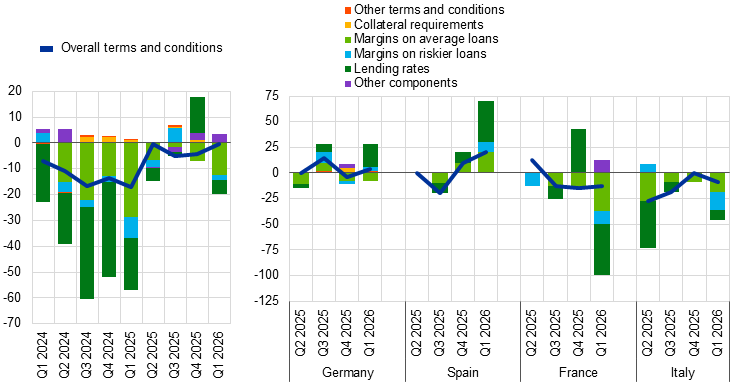
Notes: “Overall terms and conditions” are the actual terms and conditions agreed in the loan contract. “Lending rates” was introduced in April 2024. “Margins” are defined as the spread over relevant market reference rates. “Other terms and conditions” is the simple average of “loan-to-value ratio”, “other loan size limits”, “non-interest rate charges” and “maturity”. The net percentages for “Other components” refer to an average of the further terms and conditions components which were mentioned by banks as having contributed to changes in overall terms and conditions. The full set of data underlying this chart can be downloaded via the following ECB Data Portal links: euro area and four largest euro area countries.
Table 6
Changes in terms and conditions on loans to households for house purchase
(net percentages of banks)
Country |
Overall terms and conditions |
Banks’ lending rates |
Banks’ margins on average loans |
Banks’ margins on riskier loans |
||||
|---|---|---|---|---|---|---|---|---|
Q4 2025 |
Q1 2026 |
Q4 2025 |
Q1 2026 |
Q4 2025 |
Q1 2026 |
Q4 2025 |
Q1 2026 |
|
Euro area |
-4 |
0 |
14 |
-6 |
-7 |
-12 |
0 |
-2 |
Germany |
-4 |
4 |
0 |
22 |
-7 |
-7 |
-4 |
4 |
Spain |
10 |
20 |
10 |
40 |
10 |
20 |
0 |
10 |
France |
-14 |
-13 |
43 |
-50 |
-14 |
-38 |
0 |
-13 |
Italy |
0 |
-9 |
0 |
-9 |
-9 |
-18 |
0 |
-18 |
Note: See the notes to Chart 9.
In the first quarter of 2026, competition had a strong net easing impact on terms and conditions, while banks’ risk tolerance and risk perceptions had a moderate tightening effect (see Table 7). The net easing impact of competition was stronger than in the previous quarter and was reported by banks in France and Italy, whereas in Germany and Spain competition had a neutral impact. Among the largest euro area economies, banks’ risk tolerance only had a tightening impact in Germany. Banks’ risk perceptions had a strong net tightening impact in Spain, while they had a neutral effect on terms and conditions in the other three largest euro area economies.
Table 7
Factors contributing to changes in overall terms and conditions on loans to households for house purchase
(net percentages of banks)
Country |
Cost of funds and |
Pressure from |
Perception of risk |
Banks’ risk tolerance |
||||
|---|---|---|---|---|---|---|---|---|
Q4 2025 |
Q1 2026 |
Q4 2025 |
Q1 2026 |
Q4 2025 |
Q1 2026 |
Q4 2025 |
Q1 2026 |
|
Euro area |
1 |
1 |
-7 |
-12 |
2 |
3 |
1 |
4 |
Germany |
0 |
4 |
-7 |
0 |
4 |
0 |
4 |
11 |
Spain |
0 |
0 |
0 |
0 |
10 |
20 |
0 |
0 |
France |
5 |
0 |
-14 |
-25 |
0 |
0 |
0 |
0 |
Italy |
0 |
-9 |
-9 |
-18 |
0 |
0 |
0 |
0 |
Notes: The net percentages for these questions relating to contributing factors are defined as the difference between the percentage of banks reporting that the given factor contributed to a tightening and the percentage of banks reporting that it contributed to an easing. “Cost of funds and balance sheet constraints” is the simple average of “banks’ capital and the costs related to banks’ capital positions”, “access to market financing” and “liquidity position” (the aggregate series was discontinued from the first quarter 2024, when detailed sub-factors were introduced). The full set of data underlying this chart can be downloaded via the following ECB Data Portal links: euro area and four largest euro area countries.
3.3 Rejection rates for housing loans increased
The share of rejected housing loan applications increased in the first quarter of 2026 (net percentage of 3%; see Chart 10). This result follows an unchanged share in the preceding quarter. Across the four largest euro area countries, the share of rejections increased in Spain and Germany, and remained unchanged in Italy and France.
Chart 10
Changes in the share of rejected loan applications for households
(net percentages of banks reporting an increase)
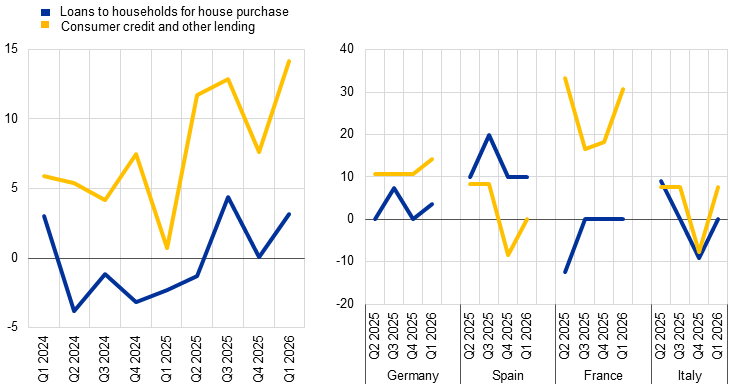
Notes: Share of rejected loan applications relative to the volume of all loan applications in that loan category. The full set of data underlying this chart can be downloaded via the following ECB Data Portal links: euro area and four largest euro area countries.
3.4 Demand for loans remained unchanged
Banks reported unchanged demand for housing loans in the first quarter of 2026 (net percentage of 0%, see Chart 11 and Overview table).[9] This follows seven consecutive quarters of net increases in demand for housing loans and was slightly below banks’ expectations (3%). A net decrease in demand was reported in Spain and Germany, while demand remained unchanged in France and Italy.
Chart 11
Changes in demand for loans to households for house purchase, and contributing factors
(net percentages of banks reporting an increase in demand, and contributing factors)
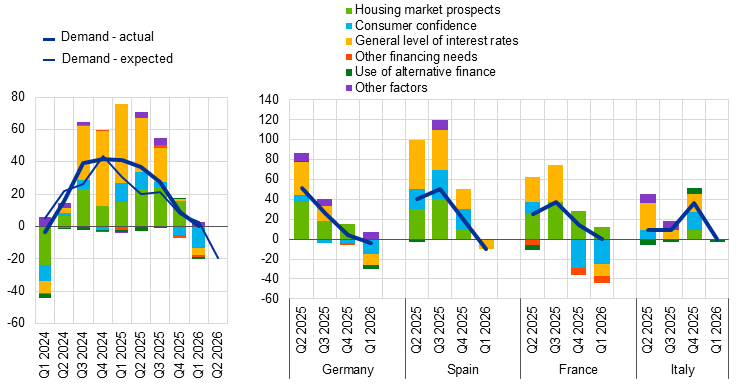
Notes: “Demand - actual” represents changes that have occurred, while “Demand - expected” represents changes anticipated by banks. Net percentages for the questions on demand for loans are defined as the difference between the sum of the percentages of banks responding “increased considerably” and “increased somewhat” and the sum of the percentages of banks responding “decreased somewhat” and “decreased considerably”. “Other financing needs” is the simple average of “debt refinancing/restructuring and renegotiation” and “regulatory and fiscal regime of housing markets”. “Use of alternative finance” is the simple average of “internal finance of house purchase out of savings/down payment”, “loans from other banks” and “other sources of external finance”. The net percentages for “Other factors” refer to an average of the further factors which were mentioned by banks as having contributed to changes in loan demand. The full set of data underlying this chart can be downloaded via the following ECB Data Portal links: euro area and four largest euro area countries.
Deteriorating consumer confidence and developments in interest rates contributed negatively to demand for housing loans (see Chart 11 and Table 8). Consumer confidence added downward pressures to changes in housing loan demand for the second consecutive quarter. It had a dampening effect in Germany and France, while it was neutral in Spain and Italy. Developments in interest rates contributed negatively for the first time since the first quarter of 2024. This factor was relevant in Germany, France and Spain, whereas it was neutral in Italy. Drivers of demand for housing loans were related to other, localised factors, while in France improved housing market prospects offset the negative contribution from other drivers.
For the second quarter of 2026, banks expect a strong net decline in demand for housing loans (net percentage of -20%). Banks in all four largest economies foresee a net decline. Banks in Germany and Spain expect a further decline after the decline observed in the first quarter of 2026, while for France and Italy, if they materialise, the net declines would mark the first negative developments in housing loan demand since the first half of 2024.
Table 8
Factors contributing to changes in demand for loans to households for house purchase
(net percentages of banks)
Country |
Housing market prospects |
Consumer confidence |
Other financing needs |
General level of interest rates |
Use of alternative finance |
|||||
|---|---|---|---|---|---|---|---|---|---|---|
Q4 2025 |
Q1 2026 |
Q4 2025 |
Q1 2026 |
Q4 2025 |
Q1 2026 |
Q4 2025 |
Q1 2026 |
Q4 2025 |
Q1 2026 |
|
Euro area |
16 |
0 |
-6 |
-13 |
-2 |
-1 |
2 |
-5 |
1 |
-1 |
Germany |
15 |
0 |
-4 |
-15 |
-2 |
0 |
0 |
-11 |
0 |
-4 |
Spain |
10 |
0 |
20 |
0 |
0 |
0 |
20 |
-10 |
0 |
0 |
France |
29 |
13 |
-29 |
-25 |
-7 |
-6 |
0 |
-13 |
0 |
0 |
Italy |
9 |
0 |
18 |
0 |
0 |
0 |
18 |
0 |
6 |
-3 |
Note: See the notes to Chart 11.
4.1 Credit standards tightened further
Banks reported a further net tightening of credit standards for consumer credit and other lending to households in the first quarter of 2026 (net percentage of 15%; see Chart 12 and Overview table).[10] Credit standards for consumer credit tightened at a higher pace relative to the previous quarter (6%). The net tightening was the highest observed since the third quarter of 2023 and was above euro area banks’ expectations in the previous quarter (10%). Credit standards tightened across all the larger euro area economies, with the current tightening exceeding historical averages in all four of the largest economies. In Germany and Italy, credit standards tightened at a pace similar to the preceding quarter, while in France and Spain, they tightened at a higher pace.
Chart 12
Changes in credit standards applied to the approval of consumer credit and other lending to households, and contributing factors
(net percentages of banks reporting a tightening of credit standards, and contributing factors)
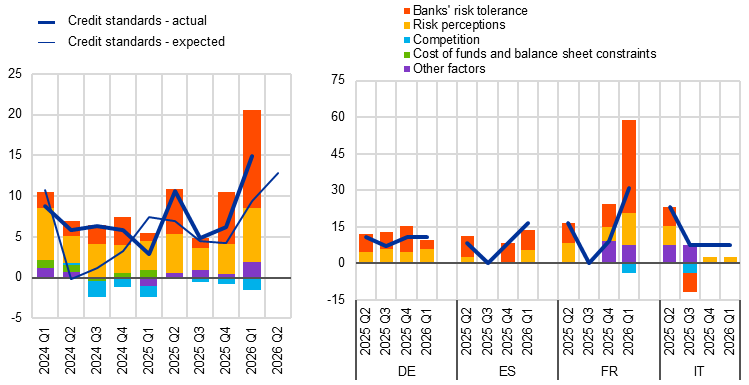
Notes: “Credit standards - actual” are changes that have occurred, while “Credit standards - expected” are changes anticipated by banks. Net percentages are defined as the difference between the sum of the percentages of banks responding “tightened considerably” and “tightened somewhat” and the sum of the percentages of banks responding “eased somewhat” and “eased considerably”. “Cost of funds and balance sheet constraints” is the simple average of “banks’ capital and the costs related to banks’ capital position”, “access to market financing” and “liquidity position” (the aggregate series was discontinued from the first quarter of 2022, when detailed sub-factors were introduced). “Risk perceptions” is the simple average of “general economic situation and outlook”, “creditworthiness of consumers” and “risk on the collateral demanded”. “Competition” is the simple average of “competition from other banks” and “competition from non-banks”. The net percentages for “Other factors” refer to an average of the further factors which were mentioned by banks as having contributed to changes in credit standards. The full set of data underlying this chart can be downloaded via the following ECB Data Portal links: euro area and four largest euro area countries.
The main drivers of the net tightening of credit standards for consumer credit were banks’ lower risk tolerance and a deterioration in banks’ risk perceptions (see Chart 12 and Table 9).[11] Higher risk perceptions were driven by concerns about both borrowers’ creditworthiness (13%) and the general economic outlook (7%). Competition had a small easing effect while banks’ cost of funds and balance sheet constraints had a broadly neutral impact. In France, the net tightening was driven by a very large contribution from lower risk tolerance, followed by higher risk perceptions, while competition had an easing impact. In Germany and Spain, banks’ lower risk tolerance and higher perceived risks contributed to the tightening. In Italy, slightly worsening risk perceptions, particularly owing to the creditworthiness of borrowers, were mentioned as a driver of the tightening.
For the second quarter of 2026, euro area banks expect credit standards for consumer credit and other lending to households to tighten further (net percentage of 13%). If it occurs, this further tightening would mark four consecutive years of uninterrupted net tightening in this segment, since the last net easing in the first quarter of 2022. Across the four largest euro area economies, all banks expect further net tightening. In France, the anticipated net tightening in credit standards would be the strongest ever reported. For the other largest euro area countries, the anticipated tightening remains less pronounced than that observed during previous episodes of peak expected tightening.
Table 9
Factors contributing to changes in credit standards for consumer credit and other lending to households
(net percentages of banks)
Country |
Cost of funds and balance sheet constraints |
Pressure from competition |
Perception of risk |
Banks’ risk tolerance |
||||
|---|---|---|---|---|---|---|---|---|
Q4 2025 |
Q1 2026 |
Q4 2025 |
Q1 2026 |
Q4 2025 |
Q1 2026 |
Q4 2025 |
Q1 2026 |
|
Euro area |
0 |
0 |
-1 |
-2 |
4 |
7 |
6 |
12 |
Germany |
0 |
0 |
0 |
0 |
5 |
6 |
11 |
4 |
Spain |
0 |
0 |
0 |
0 |
0 |
6 |
8 |
8 |
France |
0 |
0 |
0 |
-4 |
6 |
13 |
9 |
38 |
Italy |
0 |
0 |
0 |
0 |
3 |
3 |
0 |
0 |
Note: See the notes to Chart 12.
4.2 Terms and conditions tightened moderately
The overall terms and conditions applied by banks when granting consumer credit and other lending to households tightened further in the first quarter of 2026 (net percentage of 7%; see Chart 13 and Table 10).[12] This was the second consecutive quarter of net tightening of terms and conditions. Margins on average loans and developments in lending rates had a net easing impact. Across the four largest euro area economies, overall terms and conditions tightened in France and Germany, while they remained unchanged in Italy and Spain. Lending rates, margins on average and riskier loans, along with collateral requirements, contributed to the net tightening in Germany. In France, margins on average loans and lending rates had an easing impact, while margins on riskier loans and other components had a tightening impact. In Italy and Spain, lending rates and other terms and conditions related to maturity were reported as having a tightening impact, respectively.
The lower risk tolerance and higher risk perceptions of banks contributed to the tightening of overall terms and conditions, while competition had an easing effect (see Table 11). Competition only had an easing impact in France, while it had a neutral impact in all the remaining largest countries. Cost of funds and balance sheet constraints, mainly related to market financing, had a small tightening effect in Germany, France and Italy. Among the largest euro area economies, banks in Germany and France reported lower risk tolerance and higher risk perceptions.
Chart 13
Changes in terms and conditions on consumer credit and other lending to households
(net percentages of banks reporting a tightening of terms and conditions)
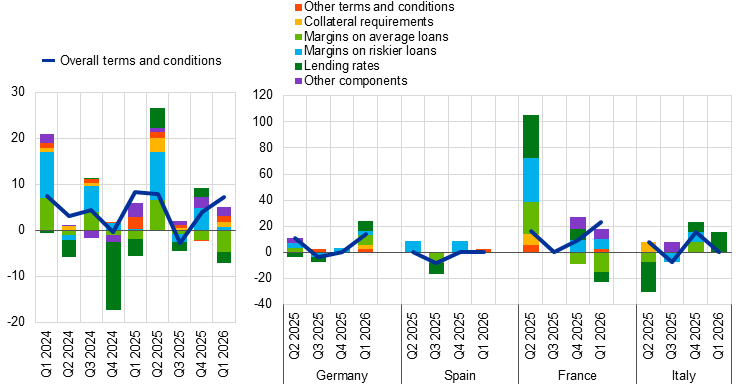
Notes: “Overall terms and conditions” are the actual terms and conditions agreed in the loan contract. “Lending rates” was introduced in April 2024. “Margins” are defined as the spread over a relevant market reference rate. “Other terms and conditions” is the simple average of “size of the loan”, “non-interest rate charges” and “maturity”. The net percentages for “Other components” refer to an average of the further terms and conditions components which were mentioned by banks as having contributed to changes in overall terms and conditions. The full set of data underlying this chart can be downloaded via the following ECB Data Portal links: euro area and four largest euro area countries.
Table 10
Changes in terms and conditions on consumer credit and other lending to households
(net percentages of banks)
Country |
Overall terms and conditions |
Banks’ lending rates |
Banks’ margins on average loans |
Banks’ margins on riskier loans |
||||
|---|---|---|---|---|---|---|---|---|
Q4 2025 |
Q1 2026 |
Q4 2025 |
Q1 2026 |
Q4 2025 |
Q1 2026 |
Q4 2025 |
Q1 2026 |
|
Euro area |
4 |
7 |
2 |
-2 |
-2 |
-5 |
5 |
1 |
Germany |
0 |
14 |
0 |
7 |
0 |
7 |
4 |
4 |
Spain |
0 |
0 |
0 |
0 |
0 |
0 |
8 |
0 |
France |
9 |
23 |
9 |
-8 |
-9 |
-15 |
9 |
8 |
Italy |
15 |
0 |
8 |
15 |
8 |
0 |
8 |
0 |
Note: See the notes to Chart 13.
Table 11
Factors contributing to changes in overall terms and conditions on consumer credit and other lending to households
(net percentages of banks)
Country |
Cost of funds and balance sheet constraints |
Pressure from competition |
Perception of risk |
Banks’ risk tolerance |
||||
|---|---|---|---|---|---|---|---|---|
Q4 2025 |
Q1 2026 |
Q4 2025 |
Q1 2026 |
Q4 2025 |
Q1 2026 |
Q4 2025 |
Q1 2026 |
|
Euro area |
0 |
2 |
-4 |
-6 |
5 |
5 |
3 |
9 |
Germany |
1 |
2 |
-4 |
0 |
0 |
11 |
0 |
11 |
Spain |
0 |
0 |
-8 |
0 |
0 |
0 |
8 |
0 |
France |
0 |
3 |
-9 |
-15 |
18 |
8 |
9 |
23 |
Italy |
-3 |
3 |
8 |
0 |
0 |
0 |
0 |
0 |
Notes: The net percentages for these questions relating to contributing factors are defined as the difference between the percentage of banks reporting that the given factor contributed to a tightening and the percentage of banks reporting that it contributed to an easing. “Cost of funds and balance sheet constraints” is the simple average of “banks’ capital and the costs related to banks’ capital positions”, “access to market financing” and “liquidity position” (the aggregate series was discontinued from the first quarter of 2024, when detailed sub-factors were introduced). The full set of data underlying this chart can be downloaded via the following ECB Data Portal links: euro area and four largest euro area countries.
4.3 Rejection rates increased further
Euro area banks reported a further strong increase in the net share of rejected loan applications for consumer credit (net percentage of 14%; see Chart 10). The reported increase was higher than the increase indicated in the previous quarter and substantially higher than the historical average (4%). Banks in Germany, France and Italy reported an increase in the share of rejections, while banks in Spain indicated unchanged rejection rates.
4.4 Demand for consumer credit decreased strongly
Banks reported a strong decline in demand, in net terms, for consumer credit and other lending to households (net percentage of -11%; see Chart 14 and Overview table). This followed a small net decline in the previous quarter. The decrease in demand for consumer credit largely contrasts with banks’ previous expectations of a minor increase (2%). Demand declined in France, Germany and Spain, whereas it increased in Italy.
Subdued spending on durable goods and lower consumer confidence were the main drivers of the decline in demand, followed by developments in the general level of interest rates (see Chart 14 and Table 12).[13] Spending on durable goods had a negative impact in France and Germany, a neutral impact in Spain and a positive impact in Italy. Consumer confidence dampened demand for consumer credit in France, Spain and Germany, whereas it had a positive impact in Italy. Changes in the general level of interest rates made a negative contribution to demand in Germany and France, whereas they had a neutral effect in Italy and Spain.
Chart 14
Changes in demand for consumer credit and other lending to households, and contributing factors
(net percentages of banks reporting an increase in demand, and contributing factors)
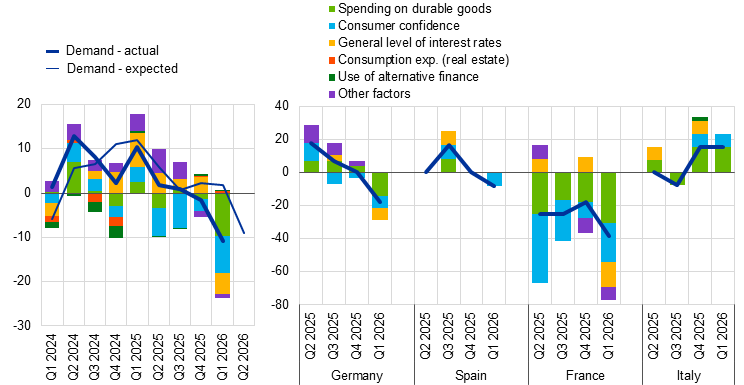
Notes: “Demand - actual” represents changes that have occurred, while “Demand - expected” are changes anticipated by banks. Net percentages for the questions on demand for loans are defined as the difference between the sum of the percentages of banks responding “increased considerably” and “increased somewhat” and the sum of the percentages of banks responding “decreased somewhat” and “decreased considerably”. “Use of alternative finance” is the simple average of “internal financing out of savings”, “loans from other banks” and “other sources of external finance”. “Consumption exp. (real estate)” denotes “consumption expenditure financed through real estate-guaranteed loans”. The net percentages for “Other factors” refer to an average of the further factors which were mentioned by banks as having contributed to changes in loan demand. The full set of data underlying this chart can be downloaded via the following ECB Data Portal links: euro area and four largest euro area countries.
For the second quarter of 2026, banks expect a decline in demand for consumer credit and other lending to households (net percentage of -9%). The expected decline follows two years of positive or neutral developments in expected demand. Demand for consumer credit is expected to decrease in France, Spain and Italy, and to remain unchanged in Germany.
Table 12
Factors contributing to changes in demand for consumer credit and other lending to households
(net percentages of banks)
Country |
Spending on durable goods |
Consumer confidence |
Consumption exp. (real estate) |
General level of interest rates |
Use of alternative finance |
|||||
|---|---|---|---|---|---|---|---|---|---|---|
Q4 2025 |
Q1 2026 |
Q4 2025 |
Q1 2026 |
Q4 2025 |
Q1 2026 |
Q4 2025 |
Q1 2026 |
Q4 2025 |
Q1 2026 |
|
Euro area |
-1 |
-10 |
-3 |
-8 |
0 |
0 |
4 |
-5 |
0 |
0 |
Germany |
4 |
-14 |
-4 |
-7 |
0 |
0 |
0 |
-7 |
0 |
0 |
Spain |
0 |
0 |
0 |
-8 |
0 |
0 |
0 |
0 |
0 |
0 |
France |
-18 |
-31 |
-9 |
-23 |
0 |
0 |
9 |
-15 |
0 |
0 |
Italy |
15 |
15 |
8 |
8 |
0 |
0 |
8 |
0 |
3 |
0 |
Note: See the notes to Chart 14.
5.1 Banks’ access to funding deteriorated for debt securities, money markets and securitisations
Euro area banks’ access to debt securities, money markets and securitisations deteriorated in the first quarter of 2026, while it remained broadly unchanged for retail funding (see Chart 15 and Table 13). [14] The deterioration in access to debt securities was the largest since the first quarter of 2023, affecting both short-term and medium to long‑term securities. Access to short-term retail funding remained unchanged, whereas access to long-term retail funding became more difficult. Banks reported a deterioration in access to money market funding. Finally, banks signalled a slight decline in access to the securitisation market (see Section 5.2 for a new ad hoc question on the broader use of securitisations by euro area banks).
Chart 15
Changes in banks’ access to retail and wholesale funding
(net percentages of banks reporting a deterioration in access)
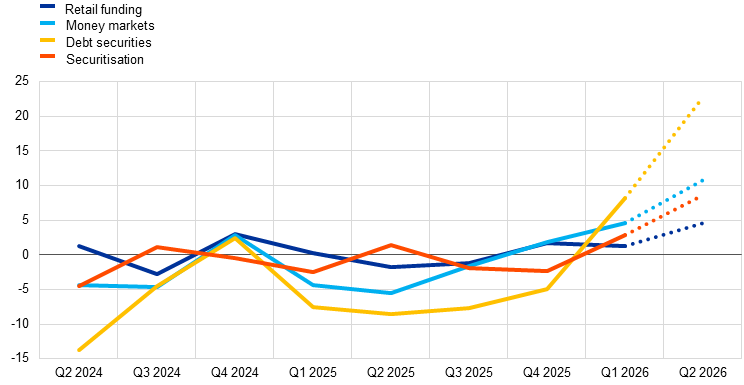
Notes: Net percentages are defined as the difference between the sum of the percentages of banks responding “deteriorated considerably” and “deteriorated somewhat” and the sum of the percentages of banks responding “eased somewhat” and “eased considerably”. “Retail funding” is the simple average of “short-term deposits (up to one year)” and “long-term deposits (more than one year)” and other retail funding instruments; “Money markets” refers to the interbank unsecured money market and is the simple average of “very short-term money market (up to one week)” and “short-term money market (more than one week)”; “Debt securities” is the simple average of “short-term debt securities (e.g. certificates of deposit or commercial paper)” and “medium to long-term debt securities (incl. covered bonds)”. “Securitisation” is the simple average of “securitisation of corporate loans”, “securitisation of loans for house purchase” and “ability to transfer credit risk off balance sheet”. The last period shows expectations indicated by banks in the current round. The full set of data underlying this chart can be downloaded via the following ECB Data Portal link: changes in banks’ access to retail and wholesale funding.
For the second quarter of 2026, banks expect access to all segments of funding to deteriorate. The expected deterioration in access to debt securities is particularly pronounced, distributed between both short-term and medium to long-term securities. If it occurs, the deterioration would be well above the historical average and the highest since the second quarter of 2022. Euro area banks also anticipate deterioration in access to money markets, securitisation and retail funding.
Table 13
Changes in bank access to retail and wholesale funding
(net percentages of banks reporting a deterioration in access)
Retail funding |
Money markets |
Debt securities |
Securiti-sation |
|||||
|---|---|---|---|---|---|---|---|---|
Total |
Short-term |
Long-term |
Total |
Short-term |
Medium to |
|||
Q4 2025 |
2 |
0 |
3 |
2 |
-5 |
3 |
-12 |
-2 |
Q1 2026 |
1 |
-1 |
4 |
5 |
8 |
9 |
7 |
3 |
Q2 2026 |
5 |
4 |
5 |
11 |
23 |
21 |
25 |
9 |
Notes: See the notes to Chart 15. The last period shows expectations indicated by banks in the current round.
5.2 Risks to credit quality had a net tightening impact on credit standards
Euro area banks reported a net tightening impact of NPL ratios and other credit quality indicators (e.g. underperforming loan or loans in early arrears) on credit standards for loans to firms and consumer credit in the first quarter of 2026 (net percentages of 5% and 7% respectively), while credit standards for housing loans remained broadly unaffected (see Chart 18 and Table 14).[15] The net tightening of credit standards for loans to firms and for consumer credit was larger than in the previous quarter (3% and 6% respectively), and slightly larger than expected (4% and 5% respectively). By contrast, the impact on credit standards for housing loans was slightly lower (-1%) than in the previous quarter, when credit quality indicators had a small tightening impact on credit standards (2%), broadly in line with previous expectations.
Chart 18
Impact of banks’ NPL ratios and other credit quality indicators on credit standards
(net percentages of banks reporting a tightening impact)
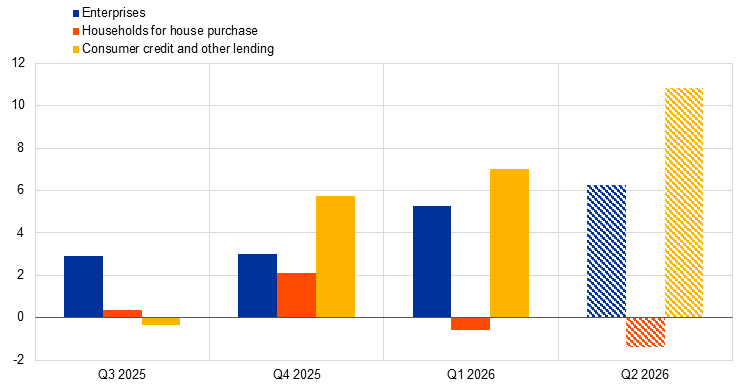
Notes: Net percentages are defined as the difference between the sum of the percentages of banks responding “contributed considerably to tightening” and “contributed somewhat to tightening” and the sum of the percentages of banks responding “contributed somewhat to easing” and “contributed considerably to easing”. The last period shows expectations indicated by banks in the current round. The full set of data underlying this chart can be downloaded via the following ECB Data Portal link: impact of banks’ NPL ratios and other indicators of credit quality on credit standards.
Table 14
Impact of banks’ NPL ratios and other credit quality indicators on credit standards
(net percentages of banks reporting a tightening impact)
Q4 2025 |
Q1 2026 |
Q2 2026 |
|
|---|---|---|---|
Loans to enterprises |
3 |
5 |
6 |
Loans to households for house purchase |
2 |
-1 |
-1 |
Consumer credit and other lending to households |
6 |
7 |
11 |
Notes: See the notes to Chart 18. The last period shows expectations indicated by banks in the current round.
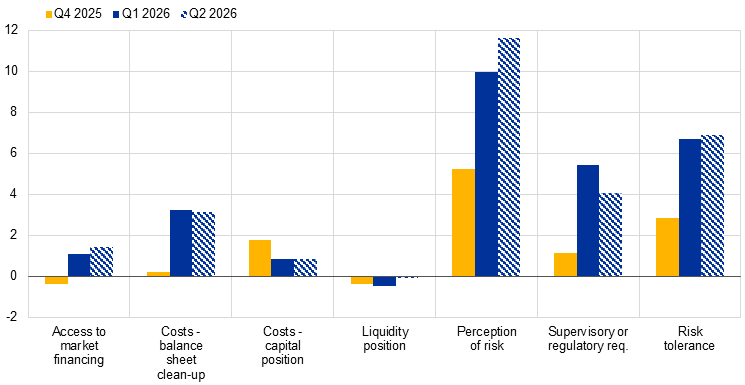
Banks indicated that higher risk perceptions, lower risk tolerance, pressure stemming from supervisory or regulatory requirements and costs related to balance sheet clean-up operations contributed to the net tightening of credit standards (see Chart 19 and Table 15). Other factors, such as costs related to the capital position, access to market financing and the liquidity position of banks had a broadly neutral impact (see also Section 5.2 on the role of securitisations in managing credit risks for euro area banks). The contribution to net tightening increased vis-à-vis the previous quarter for higher risk perceptions, lower risk tolerance, pressure stemming from supervisory or regulatory requirements and costs related to balance sheet clean-up operations.
Chart 19
Impact of factors through which NPL ratios and other credit quality indicators affect banks’ policies on lending to enterprises and households
(net percentages of banks reporting a tightening impact)
Notes: See the notes to Chart 18. As of the fourth quarter of 2025, banks’ policies on lending refer to the impact on credit standards, while the impact on terms and conditions has been discontinued. The last period shows expectations indicated by banks in the current round. The full set of data underlying this chart can be downloaded via the following ECB Data Portal link: impact of factors through which NPL ratios and other indicators of asset quality affect banks’ policies on lending to enterprises and households.
Table 15
Impact of factors through which NPL ratios and other credit quality indicators affect banks’ policies on lending to enterprises and households
(net percentages of banks reporting a tightening impact)
Q4 2025 |
Q1 2026 |
Q2 2026 |
|
|---|---|---|---|
Costs related to banks’ capital positions |
2 |
1 |
1 |
Costs related to balance sheet clean-up operations |
0 |
3 |
3 |
Supervisory or regulatory requirements |
1 |
5 |
4 |
Access to market financing |
0 |
1 |
1 |
Liquidity position |
0 |
0 |
0 |
Perception of risk |
5 |
10 |
12 |
Banks’ risk tolerance |
3 |
7 |
7 |
Notes: See the notes to Chart 19. The last period shows expectations indicated by banks in the current round.
For the second quarter of 2026, euro area banks expect credit quality to have a further tightening impact on their credit standards for loans to firms and, more markedly, for consumer credit. If this occurs, the impact would continue a trend of still contained but accelerating tightening pressure from credit quality that started in the fourth quarter of 2025. Banks anticipate that factors such as higher risk perceptions, lower risk tolerance, pressure from supervisory or regulatory requirements and costs related to balance sheet clean-up operations will have a tightening impact.
5.3 Neutral impact of interest rate decisions on bank net interest income
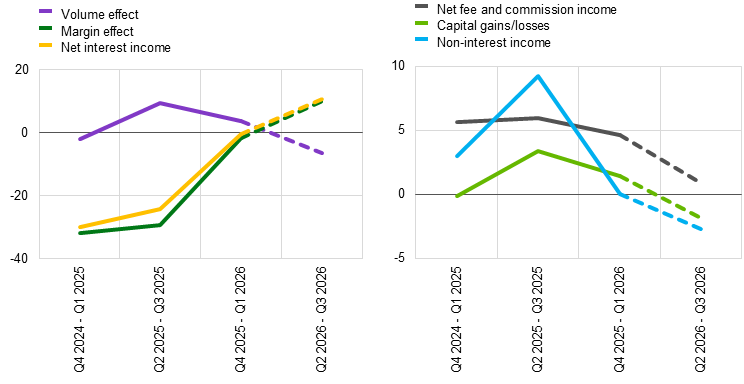
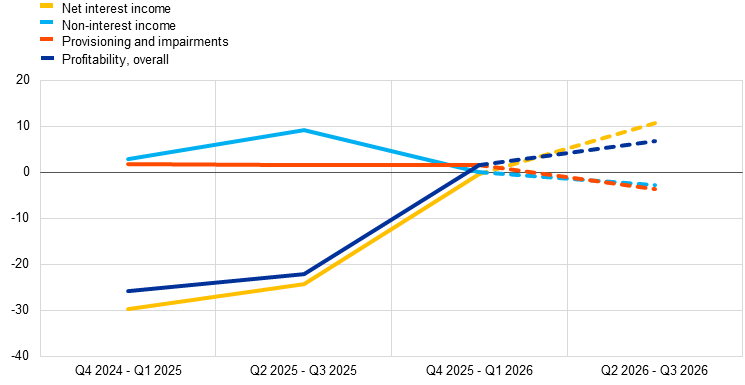
Banks reported a neutral impact of the ECB key interest rate decisions on their net interest income over the past six months (see Chart 21 and Table 16), with a small negative impact on margins offsetting a small positive impact through volumes.[16],[17] Overall, euro area banks reported a slightly positive impact on total profitability from interest rate decisions, driven by net interest income. The positive impact on net interest income through volumes was broadly in line with banks’ expectations, albeit smaller than the impact reported in the previous six months, which was the first positive value after a sequence of negative impacts linked to from the past tightening cycle. The negative impact from net interest margins was considerably smaller than the impact reported in the previous six months and well above banks’ expectations six months previously. Banks in the euro area reported a neutral impact on non-interest income, decreasing from the previous quarter and contrary to expectations of further expansion in this profitability component. Rate decisions continued to exert a small, positive impact related to lower provisioning needs and impairments.
Chart 21
Impact of the ECB’s interest rate decisions on euro area bank net interest income and non-interest income
(net percentages of banks; over the past six months and the next six months)
Notes: The net percentages refer to the difference between the sum of the percentages of banks responding “increased considerably” and “increased somewhat” and the sum of the percentages of banks responding “decreased somewhat” and “decreased considerably”. The last period denotes expectations indicated by banks in the current round. The full set of data underlying this chart can be downloaded via the following ECB Data Portal link: impact of the ECB’s interest rate decisions on euro area bank net interest income and non-interest income.
Chart 22
Impact of the ECB’s interest rate decisions on euro area bank profitability
(net percentages of banks; over the past six months and the next six months)
Notes: The net percentages refer to the difference between the sum of the percentages of banks responding “increased considerably” and “increased somewhat” and the sum of the percentages of banks responding “decreased somewhat” and “decreased considerably”. Net percentages are inverted in the case of provisioning and impairments. The last period denotes expectations indicated by banks in the current round. The full set of data underlying this chart can be downloaded via the following ECB Data Portal link: impact of the ECB’s interest rate decisions on euro area bank profitability.
Euro area banks expect lower volume effects and an increase in provisioning and impairments from ECB key interest rate decisions in the next two quarters, that would only partially dampen the overall positive impact on profitability stemming from larger expected net interest margins (see Chart 21, Chart 22 and Table 16).[18] A slightly negative impact is expected for non-interest income, driven by subdued net fee and commission income – which is expected to remain stable after having supported overall profitability dynamics since the start of interest rate cuts in mid-2024 – as well as by expected capital losses.
Table 16
Impact of the ECB’s interest rate decisions on bank profitability
(net percentages of banks reporting an increase)
Q2 2025 – Q3 2025 |
Q4 2025 – Q1 2026 |
Q2 2026 – Q3 2026 |
|
|---|---|---|---|
Profitability |
-22 |
2 |
7 |
Net interest income |
-24 |
0 |
11 |
Owing to: margin effect |
-29 |
-2 |
10 |
Owing to: volume effect |
9 |
4 |
-6 |
Non-interest income |
9 |
0 |
-3 |
Owing to: capital gains/losses |
3 |
1 |
-2 |
Owing to: net fee and commission income |
6 |
5 |
1 |
Provisioning and impairments |
2 |
2 |
-4 |
Notes: See the notes to Charts 21 and 22. The last period denotes expectations indicated by banks in the current round. The full set of data underlying this chart can be downloaded via the following ECB Data Portal link: impact of the ECB’s interest rate decisions on bank profitability.
5.4 Banks use securitisation to grant new loans, relying on non-banks to purchase securitised loans
In a new ad hoc question, banks reported on the importance of their securitisation activities, the reasons for securitising loans as well as the type and relative importance of investors purchasing their securitised loans. They also assessed the impact of securitisation on their financial situation and lending to firms over the past 12 months, as well as their expectations for the next 12 months.[19]
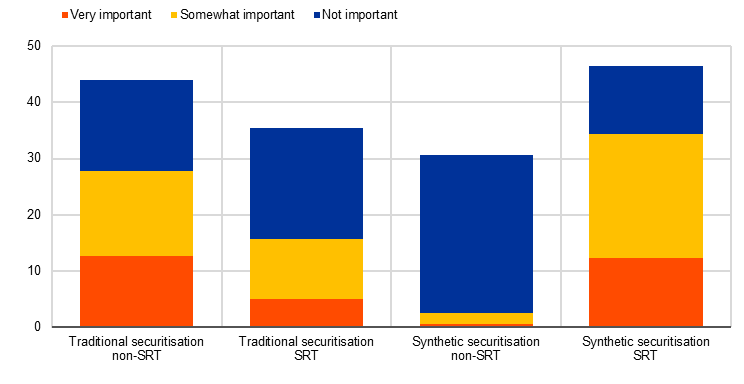
Nearly half of euro area banks engage in either traditional or synthetic securitisation, with the importance varying by type and across countries (see Chart 23 and Table 17).[20] Synthetic securitisation (SRT) was assessed as important by 34% of euro area banks (very important by 12% and somewhat important by 22%). Traditional securitisation (non-SRT) was reported as important by 28% of banks (13% banks as very important, 15% as somewhat important). Traditional securitisation (SRT) was assessed as important by 16% of banks (5% of banks as very important and 11% as somewhat important). Finally, synthetic securitisation (non-SRT) was reported as important by only 3% of banks (1% as very important and 2% as somewhat important).
Chart 23
Importance of securitisation business for banks
(percentages of banks)
Notes: Traditional securitisation involves the transfer of the legal ownership of the underlying assets to a special purpose vehicle, usually removing the asset from the banks’ balance sheets. Synthetic securitisation involves the use of credit risk derivatives or financial guarantees, with the loans remaining on the banks’ balance sheets. This can also be SRT (significant risk transfer) securitisation, to reduce the amount of regulatory capital required by the bank (see EBA Report on significant risk transfer in securitisation under articles 244(6) and 245(6) of the Capital Requirements regulation, EBA/Rep/2020/32). The full set of data underlying this chart can be downloaded via the following ECB Data Portal link: importance of banks' exposure to changes in trade policies and related uncertainty, via loans to enterprises.
Freeing up capital space to grant new loans is the primary motive reported by euro area banks to securitise loans, followed by improving the bank’s liquidity position, managing credit risks, improving access to funding, enhancing the fulfilment of regulatory or supervisory requirements, aligning with market trends and distributing capital (see Chart 24 and Table 17). Freeing up capital space to grant new loans was mentioned as an important motive by 36% of banks (13% as very important, 23% as somewhat important). Other important motives are improving the liquidity position (30% of banks), credit risk management (29%), improving access to funding (26%), meeting regulatory or supervisory requirements (23%), following market trends to be present in the business (17%) and freeing up capital to increase payouts (7%).
Euro area banks reported private investment funds and insurance corporations and pension funds as the most important investors buying securitised loans, followed by supranational institutions, other banks and other non-bank financial institutions (see Chart 25 and Table 17). The non-bank financial sector was reported as being the most important buyer of securitised loans by almost a third of euro area banks, especially private investment funds (32%) and insurance corporations and pension funds (31%) but also other non-bank financial institutions (16%). Supranational institutions and public investment funds were reported as being important investors by nearly a quarter of euro area banks (24%). Other banks were also reported as being important investors (19%), although predominantly indicated as being only “somewhat important”.
Table 17
Importance of securitisation business, motives to securitise loans and type of investors purchasing securitised loans
(percentages of banks and net percentages of banks reporting a deterioration, tightening impact or an increase)
|
Very important |
Somewhat important |
Not important |
|---|---|---|---|
Importance of securitisation business | |||
Traditional securitisation (non-SRT) |
13 |
15 |
16 |
Traditional securitisation (SRT) |
5 |
11 |
20 |
Synthetic securitisation (non-SRT) |
1 |
2 |
28 |
Synthetic securitisation (SRT) |
12 |
22 |
12 |
Motives to securitise loans | |||
Free up capital to grant new loans |
13 |
23 |
12 |
Free up capital to increase payout ratios |
2 |
5 |
34 |
Manage credit risk |
7 |
22 |
21 |
Improve liquidity position |
13 |
17 |
17 |
Improve access to funding |
6 |
20 |
18 |
Enhance fulfilment of regulatory or supervisory requirements |
5 |
18 |
22 |
Market trends (to be present in this business) |
5 |
12 |
29 |
Type of investors purchasing securitised loans | |||
Other banks |
4 |
15 |
21 |
Private investment funds |
17 |
15 |
10 |
Insurance corporations and pension funds |
11 |
20 |
14 |
Supranational institutions and public development funds |
9 |
15 |
17 |
Other non-bank financial institutions |
2 |
14 |
22 |
Other |
1 |
6 |
28 |
Notes: See the notes to Charts 22-24. For “non-performing loan (NPL) ratio and other indicators of credit quality” a higher ratio is reported as a deterioration. The last period shows expectations indicated by banks in the current round.
Euro area banks reported that securitisation contributed to sustaining loan volumes across all market segments over the past year, especially for loans to firms, while it contributed only marginally to easing credit standards over the same period (see Chart 26 and Table 17). With respect to volumes, securitisation had a marked positive impact on loan volumes in all market segments: loans to enterprises (13%), consumer credit and other lending (7%) and, to a lesser extent, loans to households for house purchase (4%).
Banks expect an increasingly positive impact on lending volumes over the next 12 months for all segments, particularly for loans to firms (19%, see Chart 26 and Table 17). Additionally, the positive impact on lending volumes is expected to continue in the next year for loans to households for house purchase (5%) and consumer credit and other lending (9%). The small easing impact across all loan categories is also expected to continue into the next year.
Chart 26
Impact of securitisation activities on banks' credit standards and lending volumes to enterprises
(net percentages of banks reporting a deterioration or tightening impact)
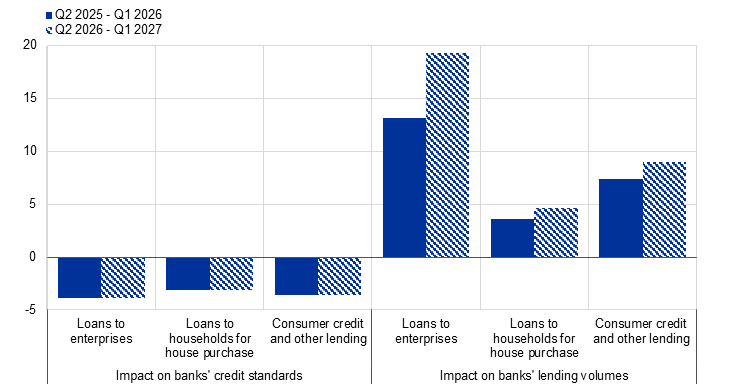
Notes: See the notes to Chart 22. The net percentage refers to the difference between the sum of the percentages for “contributed considerably to a tightening/ a decrease” and “ contributed somewhat to a tightening/ a decrease ” and the sum of the percentages for “contributed somewhat to an easing/ an increase” and “ contributed considerably to an easing/ an increase ”. The last period denotes expectations indicated by banks in the current round. The full set of data underlying this chart can be downloaded via the following ECB Data Portal link: impact of banks' exposure to changes in trade policies and related uncertainty, via loans to enterprises, on banks' situation.
Table 18
Impact of securitisation on bank’s credit standards and demand for loans to enterprises
(percentages of banks and net percentages of banks reporting a deterioration, a tightening impact or an increase)
2026 |
2027 |
|
|---|---|---|
Impact on credit standards: | ||
Loans to enterprises |
-4 |
-4 |
Loans to households for house purchase |
-3 |
-3 |
Consumer credit and other lending |
-4 |
-4 |
Impact on lending volumes: | ||
Loans to enterprises |
13 |
19 |
Loans to households for house purchase |
4 |
5 |
Consumer credit and other lending |
7 |
9 |
Notes: See the notes to Charts 22-24. For “non-performing loan (NPL) ratio and other indicators of credit quality” a higher ratio is reported as a deterioration. The last period shows expectations indicated by banks in the current round.
See more.
© European Central Bank, 2026
Postal address 60640 Frankfurt am Main, Germany
Telephone +49 69 1344 0
Website www.ecb.europa.eu
All rights reserved. Reproduction for educational and non-commercial purposes is permitted provided that the source is acknowledged.
For specific terminology please refer to the ECB glossary (available in English only).
PDF ISSN 1830-5989, QB-01-26-137-EN-N
HTML ISSN 1830-5989, QB-01-26-137-EN-Q
Legal Disclaimer:
EIN Presswire provides this news content "as is" without warranty of any kind. We do not accept any responsibility or liability for the accuracy, content, images, videos, licenses, completeness, legality, or reliability of the information contained in this article. If you have any complaints or copyright issues related to this article, kindly contact the author above.
