

Big tech, big debt: when US tech giants tap the euro area bond market
By Anne Duquerroy, Oana Furtuna, Imène Rahmouni-Rousseau and Lia Vaz Cruz
US tech giants are increasingly tapping the euro area bond market to fund their investments. The ECB Blog investigates the consequences for this market and the potential for these developments to reshape it.
The infrastructure for artificial intelligence (AI) requires huge investments. Think of the gigantic data centres and the massive electricity consumption to power them. US tech giants, including Google, Amazon and Microsoft, operate massive cloud and AI infrastructure. That is why these companies, known as hyperscalers[1], are tapping into all corners of global financial markets to fund their expansion. And increasingly they are turning to the euro area corporate bond market for some of that funding.
The growing presence of hyperscalers in the euro area corporate bond market has several consequences. For one, it could increase concentration and raise investor exposure to the technology sector and the US economy, similar to trends already felt in equity markets, where hyperscalers have become dominant. Furthermore, the surge in big tech borrowing could make it harder for other companies and other economic sectors to access finance by reshaping investors’ asset allocations. It also raises a key market-functioning question: can euro area financial markets smoothly handle such large and concentrated debt inflows?
The AI investment boom has reached euro area credit markets
Hyperscalers are projected to need more than USD 1 trillion for capital expenditure in total by 2028.[2] That equals a stunning 3% of current annual US GDP. Planned investments are becoming too large to be financed solely through internally generated cash flows. Consequently, big tech companies are shifting away from self-funding towards external sources of finance, including bond issuance.
First, hyperscalers tapped the US dollar corporate bond market and then increasingly other credit markets, not least in the euro area. This is not an unusual strategy in finance. Funding in global credit markets is the bread and butter of global firms, which have an incentive to move beyond their domestic credit market for several reasons. They may be seeking to lower their borrowing costs,[3] diversify funding sources, broaden their investor base or match expenditures in foreign currencies. Big European companies with global activities do this as well.
The large funding needs of US hyperscalers led them to follow this playbook and increase their reliance on “reverse Yankees” (bonds issued by US firms in foreign currency). In their first big wave of issuance outside the United States, hyperscalers picked the euro as the most beneficial currency for foreign funding. The euro accounts for close to 10% of the outstanding stock of bonds issued by these firms.
What volumes are we talking about? These issuers currently account for slightly over 1% of benchmark indices for euro-denominated corporate bonds, with around €40 billion of bonds outstanding. Their share in euro-denominated “reverse Yankee” issuance almost doubled between 2025 and 2026.[4] US big tech companies now represent just shy of 10% of the gross new issuance of euro-denominated bond debt attributable to non-financial corporations (Chart 1, panel a). This year alone, Amazon and Alphabet have been the largest issuers in the euro area non-financial corporate bond market, with the Amazon transaction setting an all-time size record.
Chart 1
Big tech’s rising weight in the euro area corporate bond market
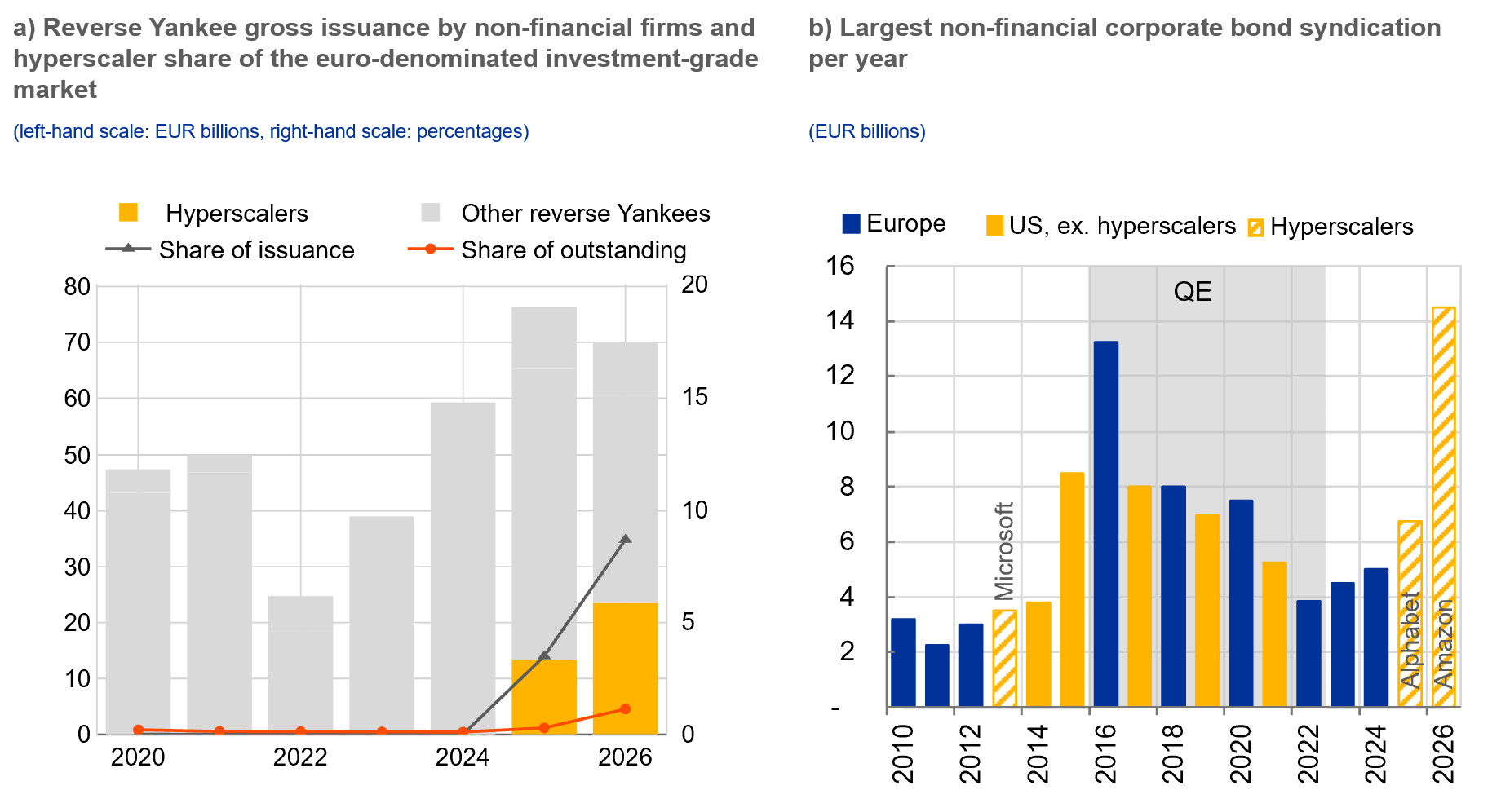
Sources: Dealogic, Bloomberg Finance L.P. and ECB calculations.
Notes: Only euro-denominated tranches issued by non-financial corporations identified using Dealogic data. Excluding private placements and convertible bonds.
Panel a: The share of issuance is the share in total euro-denominated investment-grade issuance by financial and non-financial corporations. The share of outstanding is the share in the ICE-BofA euro investment-grade corporate index. The latest observations are for 20 August 2026.
Panel b: QE stands for quantitative easing, and here specifically to the period during which the Eurosystem bought corporate securities under its corporate sector purchase programme (CSPP) and/or under Pandemic Emergency Purchase Programme (PEPP). The latest observations are for 20 August 2026.
The arrival of US big tech is shaking up old beliefs in the euro area credit market. In an economy known for being historically bank-based, euro area corporate bond markets were often perceived by issuers and investors as not having the breadth and depth to support large issuances. During the period of quantitative easing when central banks bought sovereign and corporate bonds, this started to gradually change. The euro area corporate bond market broadened its network of issuers and became a more reliable stage for funding larger investment needs.[5] Issuance of this scale signals that the euro area can absorb very large corporate bond deals on its own (Chart 1, panel b).
US big tech can broaden euro area corporate bond markets
Hyperscalers are expanding the scope of the euro area corporate bond market by introducing longer maturities, greater exposure to the technology sector and higher-rated debt. First, US big tech issues significantly longer-dated maturities than other economic sectors do. This helps build the long end of the yield curve (Chart 2, panel a), which domestic corporate issuers use less often. Second, the growing presence of hyperscalers in primary markets – and their inclusion in benchmark indices – gives bond investors greater exposure to the technology sector. This is particularly relevant in Europe. The weight of the technology sector in euro area benchmarks remains around three times lower than in comparable US indices.
Finally, hyperscalers have brought higher-rated debt to the euro area corporate bond market (Chart 2, panel b). With the current wave of debt issuance still in its early stages, these firms exhibit strong balance sheets, which translate into favourable assessments by credit rating agencies (e.g. often AA- or higher). This range complements the euro area landscape where most corporate issuers fall in the A to BBB class. As AI is a new sector, however, the way rating agencies approach this sector may be based on assumptions on future revenue growth and leverage which may not stand the test of time, heightening the vulnerability to mispricing of credit risk.
Chart 2
How the US tech sector is diversifying the euro-denominated corporate bond market
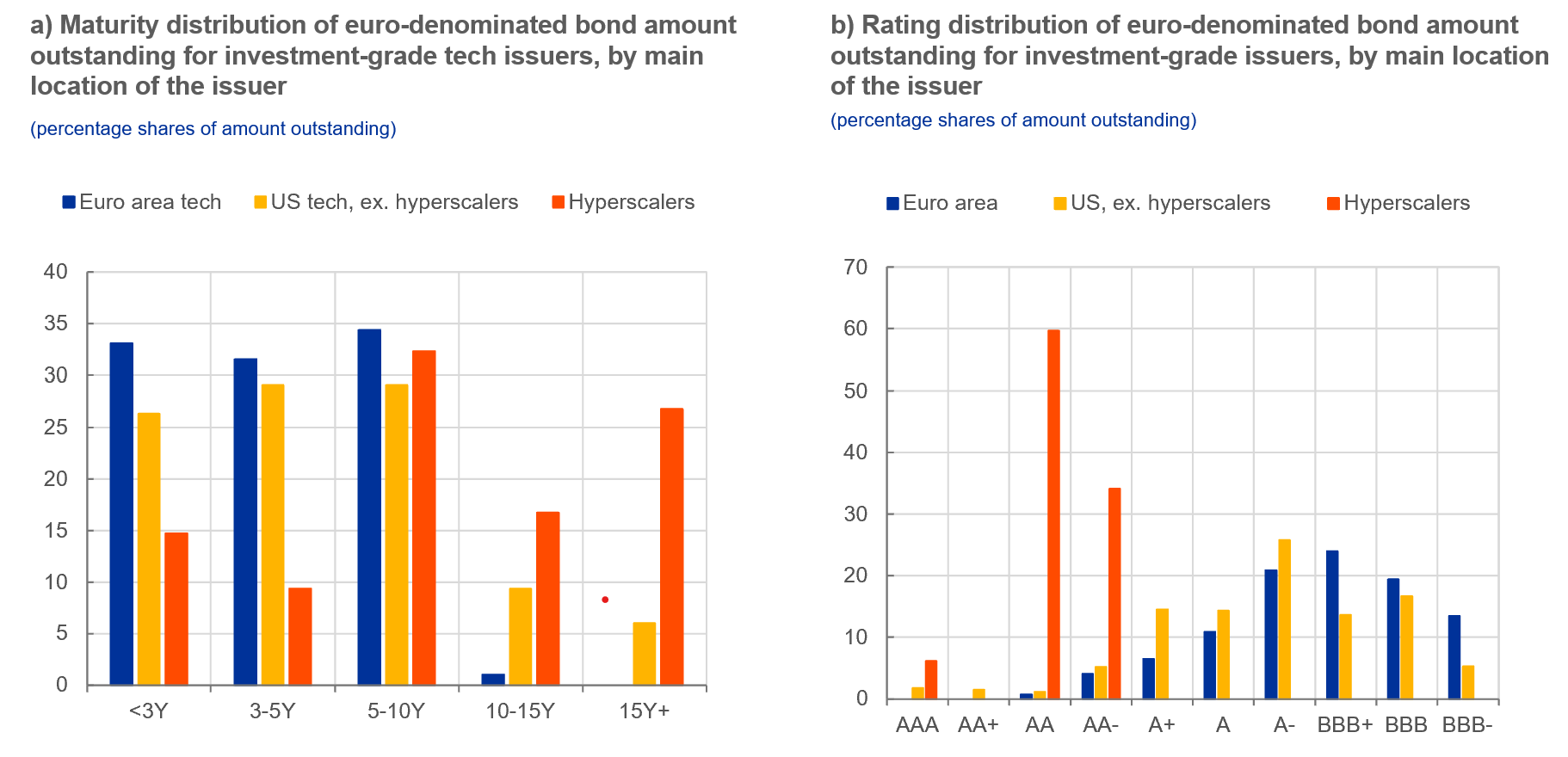
Sources: Bloomberg Finance L.P. and ECB calculations.
Notes: Panel a: Distribution of outstanding amount of debt for hyperscalers, as well as for euro area and non-hyperscaler US constituents of the Bloomberg EUR IG credit index within the technology sector, as of 20 August 2026. Panel b: Distribution of outstanding amount of debt for US and euro area constituents of the Bloomberg EUR IG credit index by rating, as of 20 August 2026. Issuers are grouped by country of incorporation of the ultimate parent. The y-axis shows which percentage of the overall debt issued by a specific category of issuer falls in the different maturity buckets. Issuers are grouped by the region of the country of incorporation.
Is there a risk of crowding-out?
Investors active in investment-grade corporate bonds denominated in euro are playing a prominent role in the financing of US hyperscalers’ capital expenditures. But does this mean that there is substantially less interest in bonds issued by euro area companies? Data analysis and market intelligence suggest that this has not been the case during this first issuance wave and that adaptation has helped.
Investors continued to show strong demand for euro-denominated hyperscaler bonds until mid-2026. Support subsequently weakened, and cover ratios − a measure of investor demand relative to the supply of a new bond − started to edge down. But this likely reflected a normalisation, as investors re-evaluated their risk compensation in light of the prospect for continuous flows of long-maturity issuance. By contrast, cover ratios for euro area issuers have remained strong and little changed throughout 2026. Some European issuers reportedly timed their issuance to avoid days when hyperscalers tapped the market, supposedly with a view to avoiding direct competition and preserving investor demand.
Investors also started to adapt, demanding greater compensation for the risks associated with hyperscaler debt. Hyperscalers’ credit spreads have started to increase on news of higher expected AI-related capital expenditure and more issuance announcements. Across all maturity segments, investors are demanding a rising risk premium to absorb the supply and deal with the greater uncertainty over the medium-term earnings outlook (Chart 3).[6]
Chart 3
Hyperscaler euro spreads edge up even as spreads of other issuers remain stable
Average credit spread of hyperscaler euro-denominated bonds across maturities and range between average spread of AA- and BBB-rated corporate issuers excluding hyperscalers |
|
(basis points) 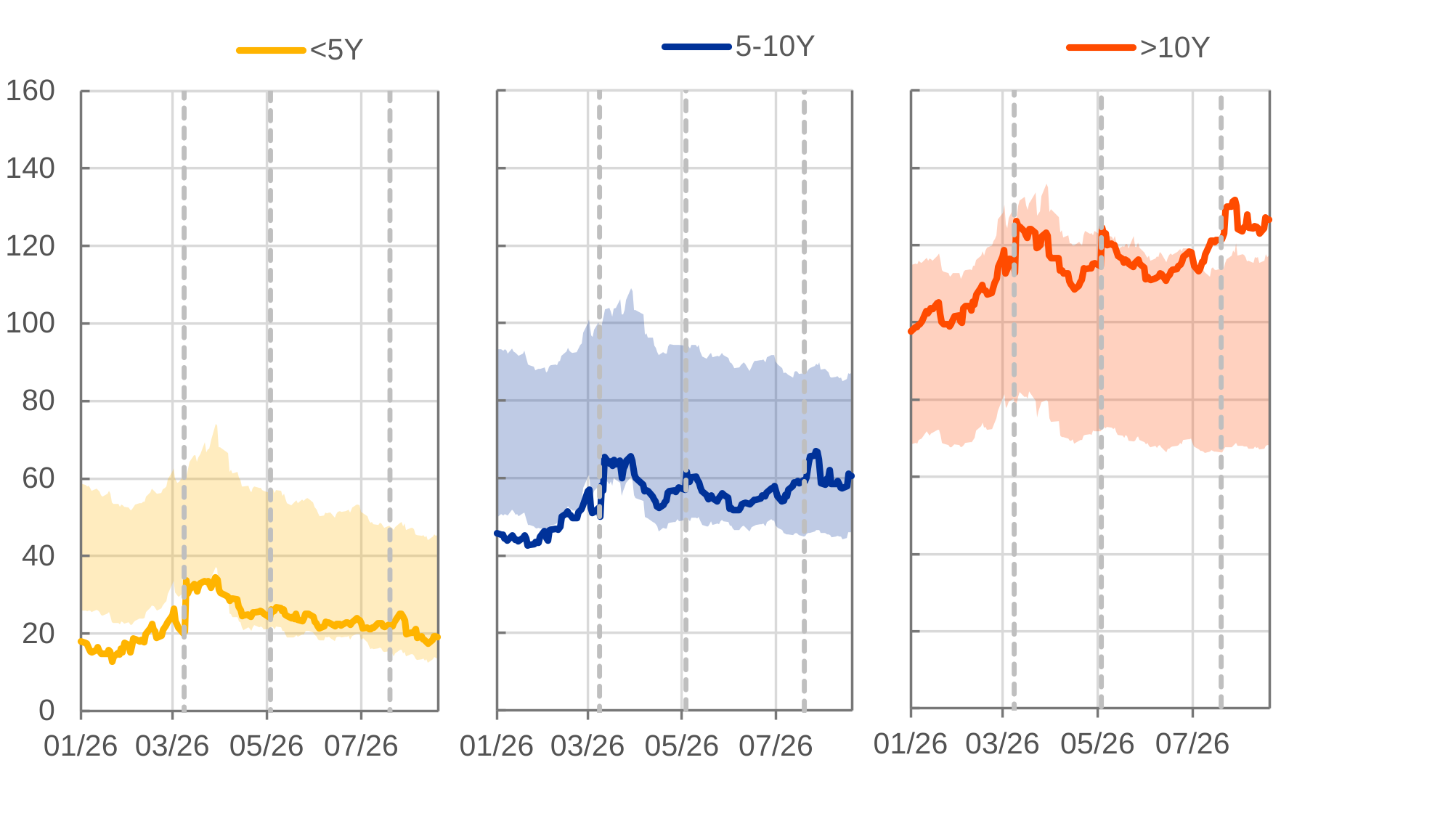
|
Sources: Bloomberg Finance L.P. and ECB calculations.
Notes: Asset swap spreads of corporate bond issuers for constituents of the Bloomberg EUR IG corporate index excluding financials. The shaded area represents the range between the index-weighted average spread of AA-rated and BBB-rated issuers, excluding hyperscalers. The curve reflects the index-weighted average of credit spreads of Alphabet, Amazon, and Microsoft, which are AA- and AAA-rated. The vertical dashed lines mark the announcement dates of Amazon Alphabet and Amazon euro-denominated issuance. The latest observations are for 20 August 2026.
Despite this reassuring initial assessment, US big tech companies could push up borrowing costs for all sectors as they accumulate debt and account for a growing share of bond markets, with a potential spillover to the sovereign and supranational segment of the bond market. This would depend in part on whether the investor “pie” is fixed, with big tech taking a larger slice, or whether it can expand to absorb the additional issuance. Spillover effects could happen through three main channels.
First, supply matters. The scale of big tech supply of new bonds may strain investor appetite. That could force hyperscalers − and similarly rated peers − to offer bonds at lower prices with wider yield spreads. The expectation of even greater bond supply in the future amplifies this effect, because investors might be reluctant to accept a current spread level if they expect even higher spreads in the future.
Second, investors have finite balance sheets and portfolio limits. They may reduce holdings of other bonds to make room for large hyperscaler deals. That could create a crowding-out effect that raises costs even for issuers from unrelated industries. Euro area investor exposure to hyperscaler debt remains relatively small for now, but is growing rapidly. Hyperscalers accounted for 15% of the increase in domestic euro-denominated corporate bond holdings in the year to March 2026, with strong demand from pension funds and insurers. For these investors looking for high-quality, long-maturity assets, hyperscaler debt may look like a possible alternative to some safe-haven style securities.
Third, bond index mechanics can amplify the effect. As hyperscalers gain weight in bond indices, passive, benchmark-tracking investors may mechanically rebalance towards them, intensifying the pressure on other bonds and further influencing spreads.
Conclusion
The rising presence of hyperscalers can bring diversification and growth to the euro area corporate bond market. For the time being, spillovers to other corporate issuers’ access to market-based funding remain limited, and the impact on investor portfolios is not substantial. In the United States, AI-driven demand for long-dated funding has reportedly contributed to the recent rise in long-term real yields. No such spillovers are evident in the euro area so far, reflecting smaller big tech issuance and resilient sovereign bond markets.
However, this could be merely the start of a financing wave of unprecedented proportions which could demonstrably reshape bond markets, including in the euro area, prompting issuers, intermediaries and investors to adapt.
While the dynamics of this adaptation are uncertain, the sheer scale of hyperscalers’ future borrowing needs, coupled with expectations of sustained strong yet uncertain earnings, warrants close monitoring. Potential international spillovers, fast-rising leverage (especially if other, less transparent, debt markets start being tapped) and broader implications for the functioning of euro area financial markets all demand close attention.
The views expressed in each blog entry are those of the author(s) and do not necessarily represent the views of the European Central Bank and the Eurosystem.
Check out The ECB Blog and subscribe for future posts.
For topics relating to banking supervision, why not have a look at The Supervision Blog?
Legal Disclaimer:
EIN Presswire provides this news content "as is" without warranty of any kind. We do not accept any responsibility or liability for the accuracy, content, images, videos, licenses, completeness, legality, or reliability of the information contained in this article. If you have any complaints or copyright issues related to this article, kindly contact the author above.
